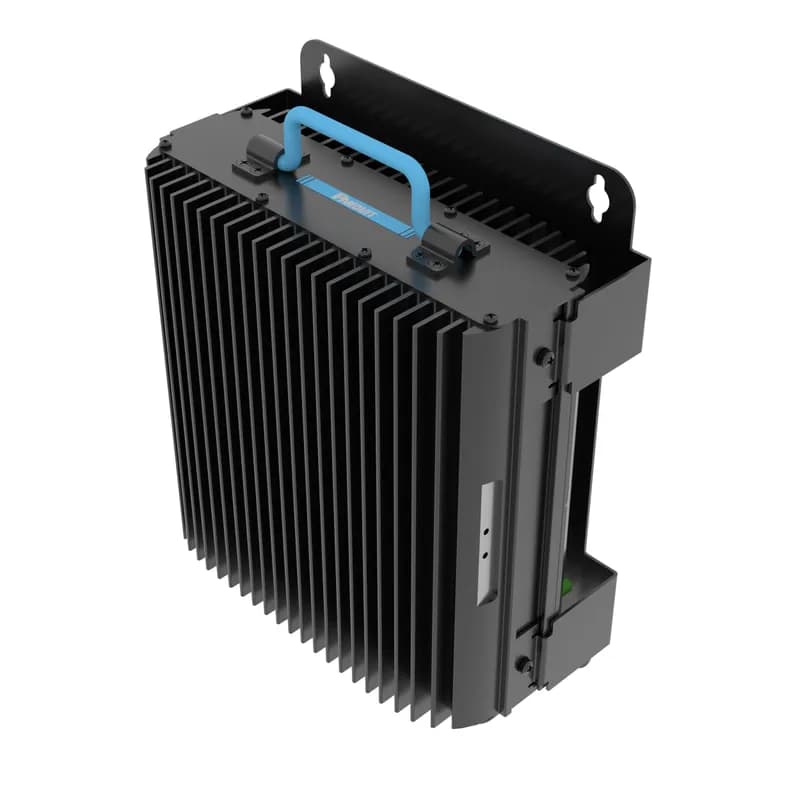
Contact for Pricing
Overview
- Three input channels for copper conductor pairs from Panduit Transmitter Modules
- Three output channels, each rated for max aggregate load of 1600W at 56VDC
- Includes connectors, wall mount bracket, and grounding lug for installation
- Designed for Class 4 power systems in industrial environments
- Compatible with Panduit’s Class 4 power infrastructure
Specifications
Connection Type | Copper conductor pairs |
Current Rating | 28.57 A (1600W/56V) |
Mounting | Wall mount |
Mounting Type | Wall Mount |
Standard | UL-1400-1 (Class 4), IEC 62368-1 and IEC 61508, EN 55032, CFR47 (FCC) Part 15 Class A, EN55035, CE, CAN ICES-3(A)/NMB-3(A), ICES-003, REACH, RoHS Compliant |
Type | Receiver |
Voltage Rating | 56 VDC |
Width | 9.4 In. |
Package Dimensions (L x W x H) | 9.45 IN x 9.4 IN x 4.2 IN |
Package Dimensions (L x W x H) | 24.003 cm x 23.876 cm x 10.668 cm |
Package Weight (Imperial) | 15.4500 L |
Package Weight (Metric) | 7.0081 kg |
Frequently Asked Questions
What is the NMC Controller?
The NMC Controller is intelligent hardware that receives an IP address, has a Graphical Web Interface, handles the Dry Contact port, and is network addressable.
How do I connect the NMC to a network?
Connect an Ethernet cable from the NMC's Network port to a switch or LAN device. The NMC defaults to DHCP and HTTPS, automatically receiving an IP or assigning an Auto IP if no DHCP server is present.
What are the specifications for the Dry Contact port?
The Dry Contact port contacts are closed during normal operation and open when the system is faulted. They are rated for 48/56VDC at 80mA.
Which web browsers are supported for the NMC GUI?
Supported web browsers include Google Chrome, Mozilla Firefox, Microsoft Edge, and Apple Safari, for both mobile and desktop versions.
What are the default login credentials for the NMC?
The default username is "admin" and the default password is "admin". A password change is required upon initial login for security purposes.
What are the password requirements for the NMC?
Passwords must be 8-40 characters long and meet three of these four rules: include a lowercase character, an uppercase character, a number, and a special character.
How do I configure email alerts on the NMC?
Configure SMTP server address, sender email, port number (default 25), sending retries (default 3), retry interval (default 6 minutes), transmission security, and password authentication in Email Setup.
What are the data log capacity and interval settings?
The data log can store up to 1000 records, overwriting the oldest entries when full. The log interval can be configured from 1 to 1440 minutes.
What user roles are available in the FMPS system?
The FMPS system offers Admin (full permissions), Controller (control functionality but no system settings changes), and Viewer (read-only) user roles.
What is the default IP addressing for the NMC?
From the factory, the NMC defaults to DHCP. If no DHCP server is present, it assigns a link-local Auto IP address, which can be discovered via mDNS.
How to Install and Set Up the Panduit FMPS PXR1AJF Receiver
This guide provides step-by-step instructions for the physical installation, wiring, and initial setup of the Panduit FMPS 56VDC Receiver (PXR1AJF). Ensure proper grounding and connections for safe and reliable operation.
Estimated time: 45m
Tools needed:
#2 Phillips screwdriver, #3 Phillips screwdriver, Slotted screwdriver, Wire stripper, Wrenches and/or pliers, Wire cutters, Compression crimp tools, Multimeter, Label maker
Supplies needed:
6 AWG receiver grounding wire, Field wiring, Copper patch wire, Receiver mounting bracket, M5x8mm screws (4), #10 wood screws (4), Grounding lugs (2, Panduit P/N LCC6-14JAW-L), Euro-style connectors for input (3, Amphenol P/N 20020002-G021B01LF), Euro-style connectors for output (3, Phoenix Contact P/N 1777833), M5 grounding screws (4), Panduit Ferrules (e.g., FSD78-6-D for 16AWG), Cable management materials (e.g., Pan-Ty cable ties)
- Ground the Receiver
Ensure proper bonded access to Earth-ground is available. Connect the 6 AWG grounding wire to the receiver using the provided grounding lugs and M5 grounding screws. Securely connect the other end of the grounding wire to an Earth-ground connection, following all national and local electrical code requirements for proper wiring methods and distances. Proper grounding is critical for functionality and electrical protection. Always follow safety and lockout/tagout procedures when working on or near electrical systems.
- Mount the Receiver
Choose a suitable mounting location for the receiver, ensuring it is within 10 feet of powered devices and not above a heat source or in direct sunlight. If mounting to a wall, use the provided mounting bracket as a template to mark and drill pilot holes, then secure the bracket with #10 wood screws or appropriate anchors. Attach the receiver to the bracket using the four M5x8mm screws. If mounting to a rack, first attach the bracket to the receiver with the M5x8mm screws, then mount the assembly to the rack using appropriate rack mounting screws. Maintain a minimum 4-inch separation if mounting multiple receivers side-by-side for proper cooling.
- Connect Input Power Cables
Connect the Class 4 cables from the Panduit FMPS Transmitter Chassis to the three input ports (labeled 1, 2, and 3) on the receiver. Each input port uses a provided Euro-style connector. Ensure proper termination of each Class 4 cable pair with Panduit Ferrules (e.g., FSD78-6-D for 16AWG) on both ends, maintaining correct polarity, and securely fasten the connectors. Ensure the Transmitter Chassis is not supplying power during wiring. Verify all connections are secure to prevent faults.
- Wire Output to Powered Devices
Connect the output cables from the receiver's three output ports (labeled 1, 2, and 3) to your powered devices. Use the provided Euro-style connectors for secure connections. Verify correct polarity for each connection. Ensure the total power draw of the connected devices does not exceed the receiver's capacity, which is approximately 500W per channel.
- Apply Power and Verify Operation
After all input and output wiring is complete and verified, apply power to the Panduit FMPS Transmitter Chassis. Observe the LED indicators on the receiver to confirm proper operation. If any fault conditions are indicated by the LEDs, refer to the troubleshooting section of the full manual or the web user interface error log to diagnose and resolve the issue before proceeding. Ensure all wiring is correctly installed and secured before applying power to avoid electrical hazards or equipment damage.
- Perform Initial System Setup via NMC
Perform the initial setup and configuration of the Panduit FMPS system, including the receiver channels, through the Network Management Card (NMC) Web Interface of the Transmitter Chassis. Connect to the NMC via Ethernet, log in for the first time, and follow the on-screen instructions to configure receiver settings, monitor power usage, and manage other system parameters. Refer to the 'Network Management Card Web Interface (GUI)' section in the main guide for detailed instructions.
Frequently Asked Questions about Panduit
What environmental ratings do Panduit products have?
Panduit products feature comprehensive environmental ratings across multiple standards, including UL 508A Type 1, 2, 3, 4, 4X, 12, and 13; CSA Type 1, 2, 3, 4, 4X, 12, and 13; and NEMA Type 1, 2, 3, 4, 4X, 12, and 13. They meet IEC 60529 IP66 rating, providing robust protection against dust, water, and corrosion in both indoor and outdoor environments, with operating temperatures ranging from -40°C to 130°C.
What certifications and standards do Panduit products comply with?
Panduit products are certified to multiple critical industry standards, including UL (Underwriters Laboratories) in the USA and Canada, CSA (Canadian Standard Association), EN IEC 61386, LVD 2006/G5/EC, and ARRA standards. Our products meet rigorous certifications for electrical safety, environmental compliance (WEEE and RoHS), and are designed to perform in extreme temperatures ranging from -55°C to 105°C, making them suitable for demanding industrial environments.
What industries and applications are Panduit products used for?
Panduit products are engineered for critical applications across multiple industries, including commercial construction, food and beverage, oil and gas, renewable energy, transportation, and safety-critical environments. Their solutions span electrical infrastructure, wire management, cable ties, power connectors, and safety systems designed to withstand extreme conditions like high vibration, temperature variations, UV exposure, and corrosive agents. Key industries include solar and wind energy, aerospace, heavy trucking, military, commercial transportation, and industrial manufacturing.
What are the main product lines offered by Panduit?
Panduit offers a comprehensive range of electrical infrastructure products including power connectors, cable ties, grounding connectors, identification products, safety solutions, terminals, cable cleats, wiring duct, and cable tie accessories. These products are engineered for industrial environments across multiple sectors like commercial construction, food and beverage, oil and gas, renewable energy, transportation, and safety applications.
What are the key features of Panduit products?
Panduit products are engineered for robust performance in heavy-duty industrial environments, featuring a comprehensive range of solutions including cable ties, power connectors, terminals, and identification products. Key features include proven quality performance, subject matter expertise, and customer-driven innovation across multiple industrial sectors such as commercial construction, food and beverage, oil and gas, renewable energy, transportation, and safety applications. The product line is designed to maximize productivity, reliability, and safety while meeting stringent industry standards.
What is Panduit's warranty policy?
Panduit provides a comprehensive Limited Product Warranty that can be fully reviewed on their official website at www.panduit.com/warranty. All Panduit products are subject to the terms, conditions, and limitations of this current warranty. Customers are advised to review the specific warranty details for their particular product, as Panduit requires buyers to determine product suitability for their intended use and assumes all associated risks.
What technical support does Panduit offer?
Panduit offers comprehensive technical support through their dedicated customer service team, accessible via phone at 1-800-777-3300. They provide expert assistance for their full range of industrial infrastructure products, including cable ties, power connectors, terminals, and identification solutions. Customers can also access additional technical resources and product information through their website at www.panduit.com.
What accessories are available for Panduit products?
Panduit offers a wide range of accessories across multiple product lines, including cable ties, cable tie accessories, cable tie tools, identification products, cable cleats, grounding connectors, and VeriSafe accessories like the VeriSafe Network Module and Insulation Piercing Connectors. For a comprehensive view of all available accessories, customers are recommended to visit www.panduit.com for the full product catalog.
How are Panduit products typically installed?
Panduit products are engineered for comprehensive installation across industrial environments, utilizing specialized tools and techniques for precise mounting. Installation methods vary by product line - from cable ties and power connectors to terminals and identification solutions - but all are designed for robust performance in heavy-duty settings. Technicians typically use Panduit's dedicated installation tools and follow manufacturer guidelines available at www.panduit.com to ensure proper fitting and maximum infrastructure reliability.