Contact for Pricing
Overview
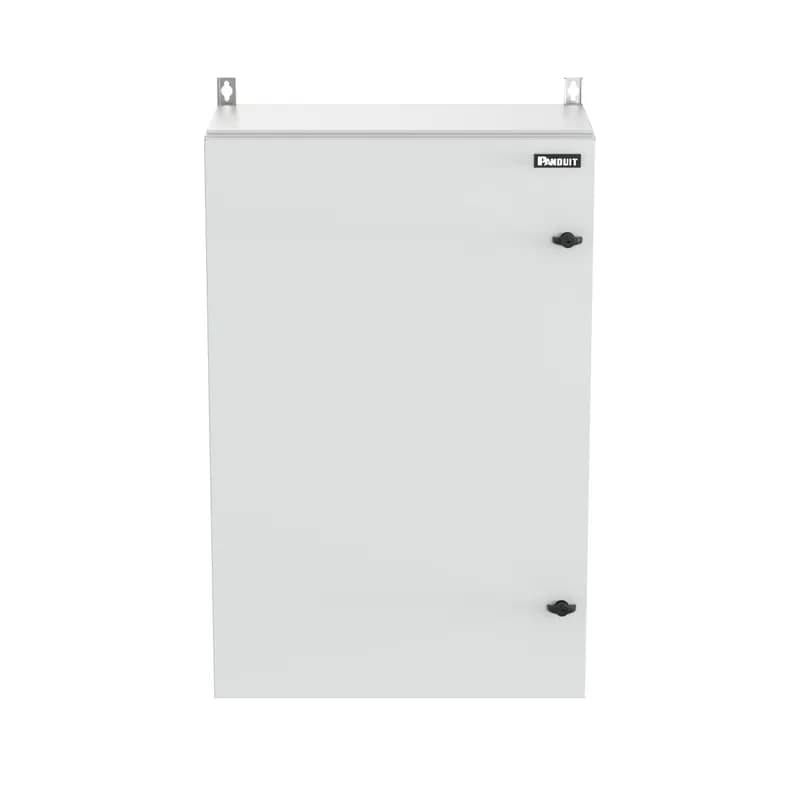
- 6RU capacity for up to 38" of active equipment depth
- Slim on-wall enclosure saves space in industrial settings
- Adjustable brackets for servers and switches
- Integrated cable and power management space
- UL NEMA Type 4/12 and IP66 certified for harsh environments
Specifications
Color | Gray |
Color | Grey |
Depth | 15.9 in |
Depth | 403.86 mm |
Material | Steel |
Standard | UL 2416, NEMA Type 4/12, IP66 |
Type | Wall Mount Enclosure |
Width | 28.6 in |
Width | 726.44 mm |
Package Dimensions (L x W x H) | 16.73 IN x 28.76 IN x 43.87 IN |
Package Dimensions (L x W x H) | 42.4942 cm x 73.0504 cm x 111.4298 cm |
Package Weight (Imperial) | 112.8700 L |
Package Weight (Metric) | 51.1978 kg |
Frequently Asked Questions
What is the Panduit IDFLP6 used for?
The Panduit IDFLP6 is a Low-Profile Industrial Distribution Frame (IDF) designed to mount active equipment vertically in an on-wall configuration within harsh environments.
What is the maximum equipment depth supported?
The IDFLP6 can accommodate active equipment with a depth of up to 38 inches, thanks to its adjustable equipment rails.
What are the environmental ratings of the enclosure?
The enclosure is rated to UL NEMA Type 4/12 and IP66, protecting internal equipment from harsh environments.
What are the dimensions of the IDFLP6 enclosure?
The IDFLP6 enclosure has a height of 43.9 inches, a width of 28.6 inches, and a depth of 15.9 inches.
How many RU does the IDFLP6 enclosure provide?
The IDFLP6 enclosure provides 6 RU of usable space for mounting equipment.
What is the maximum load rating for the enclosure?
The IDFLP6 enclosure has a load rating of 300 lbs.
What items are included with the IDFLP6 packaging?
The packaging includes the door, locking wing knobs, keys, two vertical rails, one horizontal passive equipment rail, active equipment brackets, gland plates, and mounting feet.
What material and color is the enclosure?
The IDFLP6 enclosure is made of steel and comes in a gray color.
Is the IDFLP6 enclosure RoHS compliant?
Yes, the IDFLP6 enclosure is RoHS compliant.
How can cooling units be integrated with the IDF?
The IDF is engineered with gland plates on the side, top, and bottom, allowing for the easy mounting of A/C cooling units.
How to Install the Panduit IDFLP6 Low Profile Industrial Distribution Frame
This guide provides comprehensive instructions for the physical installation, mounting, and initial cabling setup of the Panduit IDFLP6 Low Profile Industrial Distribution Frame. Follow these steps to ensure proper and compliant installation.
Estimated time: 2h 30m
Tools needed:
Tools to cut enclosure sidewalls (e.g., Greenlee punch), External power disconnect tools, #2 Phillips screwdriver, 3/8 inch socket or box wrench, 3/8 inch or 10mm drill bit (if door reversal is performed)
Supplies needed:
3/8 inch mounting hardware (bolts, nuts, washers suitable for wall type), #6 AWG infrastructure ground cable (RGJ-6PF or similar), Rigid conduit (UL Type 1, IP30 rated), Sealing washers, Flat washers, Locknuts, M6 thread forming bonding screws, Silicone sealant (if door reversal is performed), Adhesive tape (for mounting demarcation modules), Cable ties (TAK-TY or similar), Patch cords, Patch panels (e.g., Panduit CPPL24WBL), Demarcation modules (e.g., MINI-COM Six Position Multi-Media Surface Mount Box or Z-FLEX/FLEX RU-BR fiber cassette brackets)
- Prepare the Installation Site and Enclosure
Inspect the desired mounting wall to ensure it is flat and has sufficient strength to support both vertical and horizontal loads of the cabinet and equipment. Verify the wall surface extends beyond the back panel on every side. Turn the enclosure on its side with the locks oriented toward the top, then open the door using the latches. Remove the hardware bag from the enclosure and empty its contents.
- Install Wall Mount Brackets
Insert sealing washers onto the threaded studs of the mounting brackets. Install the mounting brackets with sealing washers into the back of the enclosure, aligning the threaded studs with the holes. Insert flat washers onto the threaded studs from the inside of the enclosure. Thread locknuts onto the threaded studs and tighten to 100 in-lbs. Note: Mounting brackets must be used to maintain UL compliance for the enclosure.
- Mount the Enclosure to the Wall
Choose appropriate 3/8 inch mounting hardware suitable for your wall type. Drill holes for the hardware based on your preferred mounting method. Fasten the enclosure to the wall using the appropriate hardware. Safety Warning: Be sure the wall is capable of supporting the cabinet and equipment. Panduit recommends mounting the top of the enclosure at 7 feet from the floor.
- Route Backbone and Horizontal Cabling
Ensure all RU brackets are secured with M6 bonding screws. Route backbone cable into the enclosure, preferably from the bottom, and terminate it to the appropriate fiber or copper module. Mount the module(s) in a MINI-COM Six Position Multi-Media Surface Mount Box (or Z-FLEX/FLEX RU-BR brackets) to the back wall using supplied adhesive tape or self-drilling screws. Route horizontal cable from the work area to the enclosure via UL Type 1, IP30 rated rigid conduit. Protect cables from sharp edges and allow enough slack for routing and termination.
- Install Patch Panels and Secure Cabling
Install patch panels (e.g., Panduit Part No. CPPL24WBL) to the Passive E-Rails from the bottom side. Secure all routed cables to the back wall using supplied TAK-TY cable ties. Connect horizontal cabling to active network equipment with patch cords, starting from the outside of the patch panel and working towards the middle. Route patch cords from the patch panel into the active equipment and use TAK-TYs located on the side brackets to hold them in place.
Frequently Asked Questions about Panduit
What environmental ratings do Panduit products have?
Panduit products feature comprehensive environmental ratings across multiple standards, including UL 508A Type 1, 2, 3, 4, 4X, 12, and 13; CSA Type 1, 2, 3, 4, 4X, 12, and 13; and NEMA Type 1, 2, 3, 4, 4X, 12, and 13. They meet IEC 60529 IP66 rating, providing robust protection against dust, water, and corrosion in both indoor and outdoor environments, with operating temperatures ranging from -40°C to 130°C.
What certifications and standards do Panduit products comply with?
Panduit products are certified to multiple critical industry standards, including UL (Underwriters Laboratories) in the USA and Canada, CSA (Canadian Standard Association), EN IEC 61386, LVD 2006/G5/EC, and ARRA standards. Our products meet rigorous certifications for electrical safety, environmental compliance (WEEE and RoHS), and are designed to perform in extreme temperatures ranging from -55°C to 105°C, making them suitable for demanding industrial environments.
What industries and applications are Panduit products used for?
Panduit products are engineered for critical applications across multiple industries, including commercial construction, food and beverage, oil and gas, renewable energy, transportation, and safety-critical environments. Their solutions span electrical infrastructure, wire management, cable ties, power connectors, and safety systems designed to withstand extreme conditions like high vibration, temperature variations, UV exposure, and corrosive agents. Key industries include solar and wind energy, aerospace, heavy trucking, military, commercial transportation, and industrial manufacturing.
What are the main product lines offered by Panduit?
Panduit offers a comprehensive range of electrical infrastructure products including power connectors, cable ties, grounding connectors, identification products, safety solutions, terminals, cable cleats, wiring duct, and cable tie accessories. These products are engineered for industrial environments across multiple sectors like commercial construction, food and beverage, oil and gas, renewable energy, transportation, and safety applications.
What are the key features of Panduit products?
Panduit products are engineered for robust performance in heavy-duty industrial environments, featuring a comprehensive range of solutions including cable ties, power connectors, terminals, and identification products. Key features include proven quality performance, subject matter expertise, and customer-driven innovation across multiple industrial sectors such as commercial construction, food and beverage, oil and gas, renewable energy, transportation, and safety applications. The product line is designed to maximize productivity, reliability, and safety while meeting stringent industry standards.
What is Panduit's warranty policy?
Panduit provides a comprehensive Limited Product Warranty that can be fully reviewed on their official website at www.panduit.com/warranty. All Panduit products are subject to the terms, conditions, and limitations of this current warranty. Customers are advised to review the specific warranty details for their particular product, as Panduit requires buyers to determine product suitability for their intended use and assumes all associated risks.
What technical support does Panduit offer?
Panduit offers comprehensive technical support through their dedicated customer service team, accessible via phone at 1-800-777-3300. They provide expert assistance for their full range of industrial infrastructure products, including cable ties, power connectors, terminals, and identification solutions. Customers can also access additional technical resources and product information through their website at www.panduit.com.
What accessories are available for Panduit products?
Panduit offers a wide range of accessories across multiple product lines, including cable ties, cable tie accessories, cable tie tools, identification products, cable cleats, grounding connectors, and VeriSafe accessories like the VeriSafe Network Module and Insulation Piercing Connectors. For a comprehensive view of all available accessories, customers are recommended to visit www.panduit.com for the full product catalog.
How are Panduit products typically installed?
Panduit products are engineered for comprehensive installation across industrial environments, utilizing specialized tools and techniques for precise mounting. Installation methods vary by product line - from cable ties and power connectors to terminals and identification solutions - but all are designed for robust performance in heavy-duty settings. Technicians typically use Panduit's dedicated installation tools and follow manufacturer guidelines available at www.panduit.com to ensure proper fitting and maximum infrastructure reliability.