Emerging Trends and Innovations in Industrial Automation: AGVs, Energy Analyzers, and Microgrid Breakers
2026-03-16
· Gross Automation
· 6 min read
Industrial automation is rapidly evolving, driven by innovations that enhance operational efficiency, energy management, and system reliability. For mid-sized manufacturers, staying ahead means understanding how emerging technologies like autonomous guided vehicles (AGVs), advanced energy analyzers, and intelligent low-voltage breakers can transform production and power management. This article explores these trends, focusing on practical considerations and product solutions from leading manufacturers such as Carlo Gavazzi and ABB.
Introducing AGVs and AMRs in Mid-Sized Manufacturing: Key Considerations
Autonomous Guided Vehicles (AGVs) and Autonomous Mobile Robots (AMRs) are revolutionizing material handling by reducing labor costs and improving workflow flexibility. However, mid-sized manufacturers face unique challenges when selecting and deploying these unmanned transport systems.
Understanding the Differences Between AGVs and AMRs
- AGVs follow fixed paths, typically guided by magnetic strips, wires, or reflective tape.
- AMRs use advanced sensors and onboard intelligence to navigate dynamically around obstacles.
Choosing between them depends on your facility layout, production variability, and integration needs.
Critical Factors for Successful Deployment
- Facility Layout and Flexibility
- AGVs suit environments with predictable, repetitive routes.
- AMRs excel in dynamic settings requiring adaptable navigation.
- Integration with Existing Systems
- Ensure compatibility with your Manufacturing Execution System (MES) or Warehouse Management System (WMS).
- Look for open communication protocols to facilitate seamless data exchange.
- Payload and Speed Requirements
- Match vehicle capacity and speed to your material handling needs to avoid bottlenecks.
- Safety and Compliance
- Verify that vehicles comply with industry safety standards.
- Incorporate sensors and emergency stop features to protect personnel.
- Scalability and Maintenance
- Choose systems that can scale with production growth.
- Evaluate vendor support and ease of maintenance.
Practical Example: Optimizing AGV Deployment
A mid-sized electronics manufacturer implemented AGVs to transport components between assembly lines. By selecting AGVs compatible with their existing MES and ensuring clear path mapping, they reduced manual transport time by 30%. Regular maintenance schedules and safety audits ensured uninterrupted operation.
Enhancing Energy Monitoring with Carlo Gavazzi’s Ethernet-Based EM600 Series
Accurate and timely energy data is crucial for manufacturers aiming to optimize consumption, reduce costs, and comply with sustainability goals. Traditional energy meters often lack the speed and connectivity needed for modern industrial environments.
Advantages of Ethernet-Based Energy Analyzers
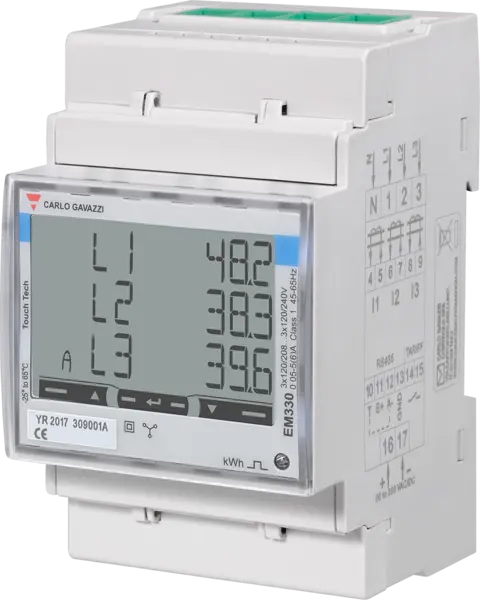
Carlo Gavazzi’s EM600 series, including models like the EM330DINAV53HS1X and EM24DINAV93XISX, offers advanced Ethernet connectivity that brings several benefits:
- Real-Time Data Acquisition
- High-speed Ethernet communication enables immediate access to energy parameters.
- Comprehensive Measurement
- Measures voltage, current, power, power factor, harmonics, and more.
- Remote Monitoring and Control
- Integrates easily with SCADA and energy management systems via Modbus TCP/IP.
- Compact DIN Rail Mounting
- Facilitates installation in standard control panels without space constraints.
- Multi-Tariff and Logging Features
- Supports detailed energy usage analysis for cost allocation and optimization.
How EM600 Series Improves Energy Management
- Faster Decision-Making: Instantaneous data allows operators to identify inefficiencies and respond quickly.
- Enhanced Reporting: Detailed logs help in compliance and continuous improvement initiatives.
- Reduced Downtime: Early detection of anomalies prevents equipment damage and production losses.
Implementation Tips
- Ensure your network infrastructure supports reliable Ethernet communication.
- Use Carlo Gavazzi’s software tools for configuration and data visualization.
- Combine multiple EM600 analyzers to monitor different plant sections for granular insights.
Intelligent Low-Voltage Breakers: Empowering Industrial Microgrids
As manufacturers increasingly adopt microgrids to integrate renewable energy and improve power reliability, managing distributed energy sources becomes complex. ABB’s intelligent low-voltage breakers provide a smart solution tailored for these challenges.
Key Benefits of ABB Intelligent Low-Voltage Breakers
- Advanced Protection and Control
- Protect circuits from overloads and short circuits with precise trip settings.
- Enable remote operation and status monitoring.
- Energy Management Integration
- Communicate with energy management systems to optimize load distribution.
- Fault Detection and Diagnostics
- Quickly identify and isolate faults to minimize downtime.
- Support for Renewable Integration
- Manage bidirectional power flows typical in microgrids with solar or battery storage.
- Compact and Modular Design
- Simplifies panel design and future expansion.
Use Case: Microgrid Reliability in Manufacturing
A food processing plant integrated ABB intelligent breakers to manage its solar array and backup generators. The breakers’ communication capabilities allowed seamless switching between power sources, ensuring continuous operation during grid disturbances and reducing energy costs.
Deployment Recommendations
- Coordinate breaker settings with your microgrid controller for optimal performance.
- Train maintenance staff on interpreting breaker diagnostics.
- Plan for scalability as your microgrid expands.
Improving Manufacturing Asset Management with Electronic Component Traceability
Quality and compliance demands in manufacturing are driving the need for detailed traceability of electronic components. Traceability services, such as those recently launched by manufacturers like OKI, provide rapid reporting on component provenance and specifications.
Why Traceability Matters
- Quality Assurance: Verify component authenticity and performance history.
- Regulatory Compliance: Meet industry standards and customer requirements.
- Recall Management: Quickly identify affected batches in case of defects.
- Inventory Optimization: Improve procurement and stock management decisions.
Implementing Traceability in Your Facility
- Use barcoding or RFID tagging to track components from receipt to assembly.
- Integrate traceability data with your MES or ERP systems.
- Partner with suppliers offering fast and reliable traceability reports.
Practical Impact
Mid-sized manufacturers leveraging traceability services have reduced product failures and improved customer satisfaction by ensuring only verified components are used in production.
Conclusion: Leveraging Innovations with Gross Automation
Emerging technologies like AGVs/AMRs, Ethernet-based energy analyzers, and intelligent low-voltage breakers are reshaping industrial automation. For mid-sized manufacturers, understanding these innovations and selecting the right products is crucial to enhancing efficiency, safety, and sustainability.
Gross Automation offers expert guidance and a broad portfolio of solutions from trusted manufacturers like Carlo Gavazzi and ABB. Whether you’re deploying autonomous transport systems, upgrading energy monitoring, or managing microgrids, our team can help you navigate the complexities and implement the best-fit technologies.
Contact Gross Automation today to explore how these innovations can transform your manufacturing operations.
Quick Answers from Products
What devices are compatible with the OptoProg?
The OptoProg is compatible with WM20, WM30, WM40, WM50, ET112, ET330, and ET340 analyzers.
From: OPTOPROG by Carlo GavazziWhat is the operating temperature range for the EM24 energy analyzer?
The device can operate in temperatures ranging from -25 to +55 °C (-13 to +131 °F).
From: EM24DINAV23XE1X by Carlo GavazziWhat is the storage temperature range for the EM24 energy analyzer?
The storage temperature range for the EM24 is from -30 to +70 °C (-22 to +158 °F).
From: EM24DINAV23XE1X by Carlo GavazziRelated Articles
Choosing and Implementing Efficient Motor Drivers and Controllers for DC and Brushless Motors
6 min readEmerging Trends and Competitive Strategies in Factory and Logistics Automation
4 min readWhen Does It Make Sense for SMBs to Automate? Evaluating ROI from PLCs to Full DCS and SCADA Systems
10 min readNavigating Obsolescence: Upgrading Legacy GE Surge Protective Devices Before 2026
6 min read