
Contact for Pricing
Overview
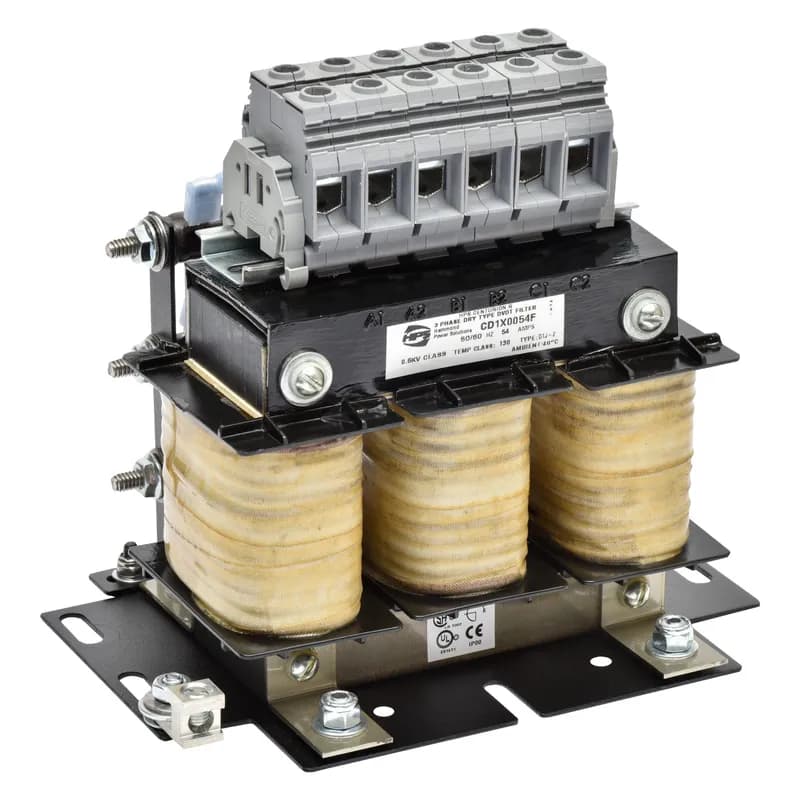
- The dV/dT filter combines an inductor and parallel resistor network to mitigate both high frequency components and voltage spikes between the VFD and motor.
- The filter can mitigate the effects of reflected wave voltages greater than what a reactor alone can accomplish.
- The filter provides protection to the motor by slowing down the rate of voltage increase and minimizes the damaging peak voltages that occur within the motor’s windings and along the length of cables feeding the motor.
- Open style design for flexible integration
- Extends motor lifespan and prevents insulation failure
Specifications
Application | Designed for applications with long cables between the VFD and the motor |
Cooling | Natural Convection |
Current Rating | 4 A |
Enclosure | Open Frame |
Height | 44 IN |
Inverter Specification | Switching Frequency: 2kHz - 4kHz, Operating Frequency: up to 60Hz |
Length | 16 IN |
Maximum Ambient Temperature | 40C (suitable to 50C) |
Minimum Ambient Temperature | -25C |
Mounting | Wall/Ceiling/Floor Mount |
Peak Voltage | at Motor: 150% of DC bus voltage |
Standard | cUL |
Voltage Rating | up to 600V |
Weight | 1000 lbs |
Width | 23 IN |
Package Dimensions (L x W x H) | 6 IN x 8 IN x 5.5 IN |
Package Dimensions (L x W x H) | 152.4 mm x 203.2 mm x 139.7 mm |
Package Weight (Imperial) | 4.0000 L |
Package Weight (Metric) | 1.8000 kg |

How to Install the HPS Centurion P Passive Harmonic Filter
This guide provides step-by-step instructions for the installation and initial setup of the HPS Centurion P Passive Harmonic Filter, ensuring safe and effective operation.
Estimated time: 1h
Tools needed:
Screwdriver, Wire strippers, Multimeter, Forklift
Supplies needed:
Mounting screws, Terminal connectors, Grounding wire
- Inspect the unit
Immediately after receiving the Passive Harmonic Filter, inspect it for any transit damage and ensure all parts are accounted for against the shipping documents.
- Mount the filter
Using a forklift, carefully position the Passive Harmonic Filter in the designated installation location, ensuring at least 6 inches of clearance from walls and obstructions for ventilation.
- Ground the filter
Connect the designated main grounding location of the Passive Harmonic Filter to a proper ground to ensure safe operation before energizing the unit.
- Make electrical connections
Connect the input terminals A1, B1, and C1 to the corresponding phases of the power supply, and connect A2, B2, and C2 to the load, following the nameplate diagram.
- Verify connections
Use a multimeter to verify that all electrical connections are secure and that there is no voltage present before proceeding to energize the unit.
- Energize the filter
Once all connections are verified, turn on the upstream circuit breaker or disconnect to energize the Passive Harmonic Filter.
- Perform initial testing
Use a power quality analyzer to measure total harmonic distortion and power factor before and after connecting the filter to establish a baseline for performance.
Frequently Asked Questions about Hammond Power
What certifications and standards do Hammond Power products comply with?
Hammond Power products are certified to UL (Underwriters Laboratories) and CSA (Canadian Standards Association) standards in North America. Our products meet rigorous safety and performance requirements, with many items classified as UL Listed Products or Recognized Components. We also comply with international certifications including China Compulsory Certification (CCC), C-Tick for Australian EMC requirements, and ANCE for Mexico.
What is Hammond Power's warranty policy?
Hammond Power provides a standard one-year warranty on all products, covering defects in workmanship and materials. Products will be repaired or replaced free of charge if found defective upon factory inspection. The warranty does not cover damage from improper handling, incorrect application, or faulty installation.
What industries and applications are Hammond Power products used for?
Hammond Power products are engineered for critical industrial and commercial applications across multiple sectors, including petrochemical, mining, construction, renewable energy, e-mobility, power storage, and microgrids. Their comprehensive product range of dry-type transformers, power quality solutions, and magnetic components enables electrical distribution and electrification in diverse industrial environments worldwide.
What are the main product lines offered by Hammond Power?
Hammond Power Solutions offers a comprehensive range of dry-type and liquid-filled transformers for industrial and commercial applications. Their primary product lines include power transformers for renewable energy, e-mobility, data centers, microgrids, and industrial settings. The company provides both standard and custom-designed transformer solutions that are critical to electrical distribution networks across multiple industries.
What are the key features of Hammond Power products?
Hammond Power products feature advanced dry-type and liquid-filled transformers engineered for diverse industrial applications, with capabilities spanning renewable energy, e-mobility, data centers, microgrids, and industrial/commercial sectors. Key features include high-performance electrical steel laminations, windings available in copper or aluminum, advanced insulation systems (VPI or Cast Resin), Basic Impulse Level ranges from 10 kV to 250 kV, and custom design capabilities with over 3,000 unique transformer designs engineered annually.
What environmental ratings do Hammond Power products have?
Hammond Power offers industrial enclosures with comprehensive environmental ratings, including UL/cUL 508A ratings of Type 1, 2, 3, 4, 4X, 12, and 13. Their products meet IEC 60529 IP66 standards, providing robust protection against dust, water ingress, and harsh environmental conditions. Specific ratings vary by product series, with options ranging from indoor Type 1 enclosures to outdoor-rated Type 4X enclosures suitable for challenging industrial environments.
What technical support does Hammond Power offer?
Hammond Power Solutions provides comprehensive technical support through multiple channels. Customers can access technical resources via phone support in Canada, the United States, Mexico, and internationally, with toll-free numbers and regional contact points. Their technical team offers personalized assistance for custom design inquiries, helping customers find standard transformer and power solutions or develop specialized electrical products for various industrial applications.
What communication protocols do Hammond Power products support?
Hammond Power products support multiple industrial communication protocols, including Modbus RTU, PROFIBUS DP, PROFINET, EtherNet/IP, and CANopen. These protocols enable flexible connectivity across industrial automation platforms, supporting various network topologies and high-speed data transmission for comprehensive industrial control and monitoring applications.
What accessories are available for Hammond Power products?
Hammond Power offers a comprehensive range of accessories for industrial electrical components, including HME Series handles with key locking and padlocking options, door stop kits, light kit mounting brackets, and standard hardware like mounting screws and washers. These accessories are designed to enhance functionality and installation flexibility across their product lines.
How are Hammond Power products typically installed?
Hammond Power transformers are typically chassis-mounted using precise mounting hole centers and dimensions specific to each product series. Installation involves selecting the appropriate primary voltage configuration, securing the transformer to a mounting surface using the specified mounting holes, and connecting terminals according to the product's schematic. Most Hammond Power transformers feature multiple terminal options like solder or quick-connect terminals, allowing flexible and straightforward installation in industrial control and power distribution applications.