
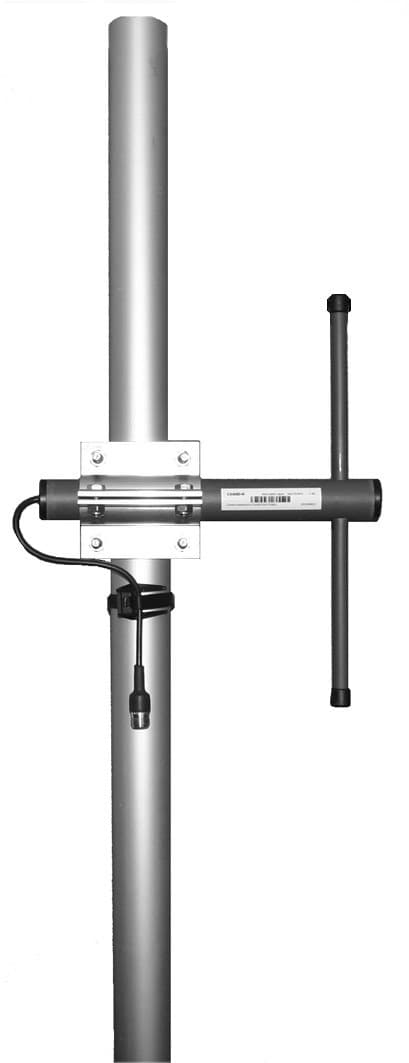
CompleTech CA380C4 offset pattern collinear - Frequency range: 365-395 MHz - Gain: 11 dBi - Polarization…
Documents & Media
Contact for Pricing
Call +1 (262) 252-1600 (toll-free 877-268-3700) or email [email protected] for pricing and availability.
Overview
- Frequency range: 365-395 MHz for targeted wireless applications
- Gain: 11 dBi with vertical polarization for strong signal performance
- VSWR <1.5 ensures minimal signal reflection and maximum efficiency
- IP67-rated radome with UV-resistant ABS/FG and PU foam filling for weather resistance
- Mounts to 35-60 mm diameter poles with aluminium bracket and stainless steel hardware
Specifications
Connection Type | N-/TNC-female |
Connector | N-/TNC-female |
Frequency | 365-395 MHz |
Gain | 11 dBi |
Length | 2765 mm |
Material | ABS/FG PU foam, copper |
Mounting Diameter | Ø 35-60 |
Mounting Type | 35-60 mm diameter pole |
Polarization | vertical |
Radiator Material | copper |
Radome | ABS/FG, PU foam |
Series | CA380C4 |
VSWR | <1.5 |
Weight | 3600 g |
Wind Load | 140 N @ 150 km/h |
CA930C4
offset pattern collinear - Frequency range: 880-960 MHz - Gain: 11 dBi - Polarization: vertical - Connector: N-female - VSWR: <1.5 - Radome: ABS/FG PU foam - Radiator material: copper - Mounting: 35-60 mm diameter pole - Wind load: 100 N

CA85D
offset pattern dipole - Frequency range: 83-88 MHz - Gain: 5 dBi - Polarization: vertical/horizontal - Connector: N-/ TNC-/ 7/16-female - VSWR: <1.5 - Radome: ABS/FG PU foam - Radiator material: copper - Mounting: 35-60 mm diameter pole - Wind load: 84 N
CA170C3
offset pattern collinear - Frequency range: 163-177 MHz - Gain: 10 dBi - Polarization: vertical - Connector: N-/TNC-female - VSWR: <1.5 - Radome: ABS/FG PU foam - Radiator material: copper - Mounting: 35-60 mm diameter pole - Wind load: 165 NCA860C4
offset pattern collinear - Frequency range: 830-890 MHz - Gain: 11 dBi - Polarization: vertical - Connector: N-female - VSWR: <1.5 - Radome: ABS/FG PU foam - Radiator material: copper - Mounting: 35-60 mm diameter pole - Wind load: 100 N
CA140B4
bidirectional stacked broadside - Frequency range: 135-145 MHz - Gain: 9 dBi - Polarization: vertical - Connector: N-/TNC-female - VSWR: <1.5 - Radome: ABS/FG PU foam - Radiator material: copper - Mounting: 35-60 mm diameter pole - Wind load: 252 NCA150C3
offset pattern collinear - Frequency range: 144-156 MHz - Gain: 10 dBi - Polarization: vertical - Connector: N-/TNC-female - VSWR: <1.5 - Radome: ABS/FG PU foam - Radiator material: copper - Mounting: 35-60 mm diameter pole - Wind load: 180 NFrequently Asked Questions
What is the operating temperature range for the CA380C4 antenna?
The antenna can operate in temperatures ranging from -40ºC to +80ºC.
What is the impedance of the CA380C4 antenna?
The impedance of the CA380C4 antenna is 50 ohm.
What is the gain of the CA380C4 antenna?
The gain of the CA380C4 antenna is 11 dBi.
What are the -3 dB beamwidths for the CA380C4 antenna?
The H -3 dB beamwidth is 182º and the E -3 dB beamwidth is 13º.
What type of connector does the CA380C4 antenna use?
The CA380C4 antenna uses an N-female or TNC-female connector.
What is the VSWR rating for the CA380C4 antenna?
The VSWR rating for the CA380C4 antenna is less than 1.5.
What materials are used for the radome and radiator of the CA380C4 antenna?
The radome is made of UV resistant ABS/FG with PU foam filling, and the radiator is made of copper.
What is the lightning protection method for the CA380C4 antenna?
The CA380C4 antenna features DC-short circuited lightning protection.
What is the IP rating of the CA380C4 antenna?
The CA380C4 antenna has an IP67 rating, indicating it is dust-tight and protected against immersion in water.
What is the front-to-back ratio (F/B) of the CA380C4 antenna?
The F/B ratio of the CA380C4 antenna is between 4-10 dB, depending on the mounting.
How to Install the CA380C4 Controller
This guide provides step-by-step instructions for installing and configuring the CA380C4 Controller, ensuring proper wiring and initial setup.
Estimated time: 45m
Tools needed:
Screwdriver, Wire strippers, Multimeter
Supplies needed:
Mounting screws, Terminal connectors, Self-amalgamating tape
- Mount the controller
Secure the CA380C4 controller to the designated mounting surface using the provided mounting screws. Ensure it is level and firmly attached.
- Connect the wiring
Strip the ends of the wires and connect them to the appropriate terminals on the CA380C4 controller. Use terminal connectors to ensure a secure connection.
- Seal the connections
Cover all connectors and cable junctions with self-amalgamating tape to provide weather protection and prevent moisture ingress.
- Verify connections
Use a multimeter to check the continuity of the connections. Ensure all wires are properly connected and there are no shorts.
- Power on the controller
Turn on the power supply to the CA380C4 controller and observe the indicator lights to confirm it is functioning correctly.