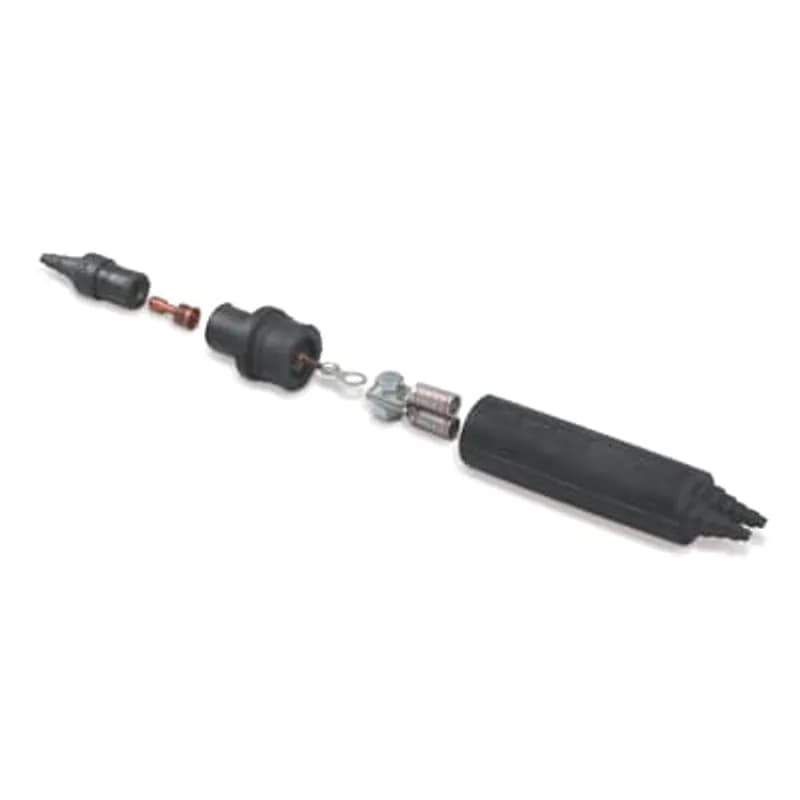
ABB Installation Products DYC 2/0 Flood-Seal Street and Highway Lighting Mechanical Fuse and Disconnect Kits Y-Type with…
UPC: 783786717699
Documents & Media
Contact for Pricing
Call +1 (262) 252-1600 (toll-free 877-268-3700) or email [email protected] for pricing and availability.
Overview
- ABB Flood-Seal Street and Highway Lighting Mechanical Fuse and Disconnect Kit
- Y-Type configuration with crimped lug connectors
- Non-fused unit
- Designed for stranded 2/0 copper run wire
- Includes installing dies: 9/16, 13, TS, 45
Specifications
Amperage Rating | 30 A |
Application | Rated 600V, 30 Amps Maximum, perfect for heavy-duty applications |
Color | Black |
Conductor Range | 2/0 Copper AWG |
Connection | Compression |
Connection Type | Crimped Lug |
Environmental Conditions | WaterTight |
Insulation | True |
Length | 9-3/4 in |
Material | Copper |
Material | Copper Connector, EPDM-Rubber Housing |
Number of Conductors | 3 |
Series | DYC |
Size | 2/0 |
Special Features | EPDM Flood-Seal Housing ensures a fully insulated, watertight, and submersible connection. Safe separations to ensure fuse or connecting link stays in load side when separated. Dual-Rated. Approved for a wide range of aluminum or copper connections |
Type | Break-Away Streetlight Kits |
Voltage Rating | 600V |
Package Dimensions (L x W x H) | 0.01 IN x 0.01 IN x 0.01 IN |
Package Dimensions (L x W x H) | 0.0254 cm x 0.0254 cm x 0.0254 cm |
Package Weight (Imperial) | 1.0000 L |
Package Weight (Metric) | 0.4540 kg |

CT250
Single Screw Cable Tap with Spacer, for Copper Conductor. Wire Size Main: 250 kcmil - 2/0 Branch: 250 kcmil - 2, 2-1/2 inch x 1-1/4 inch, Packed with Hex Wrench. Black Oxide Steel Screw, Copper Alloy Body. Copper Screw Bracket. Copper Spacer.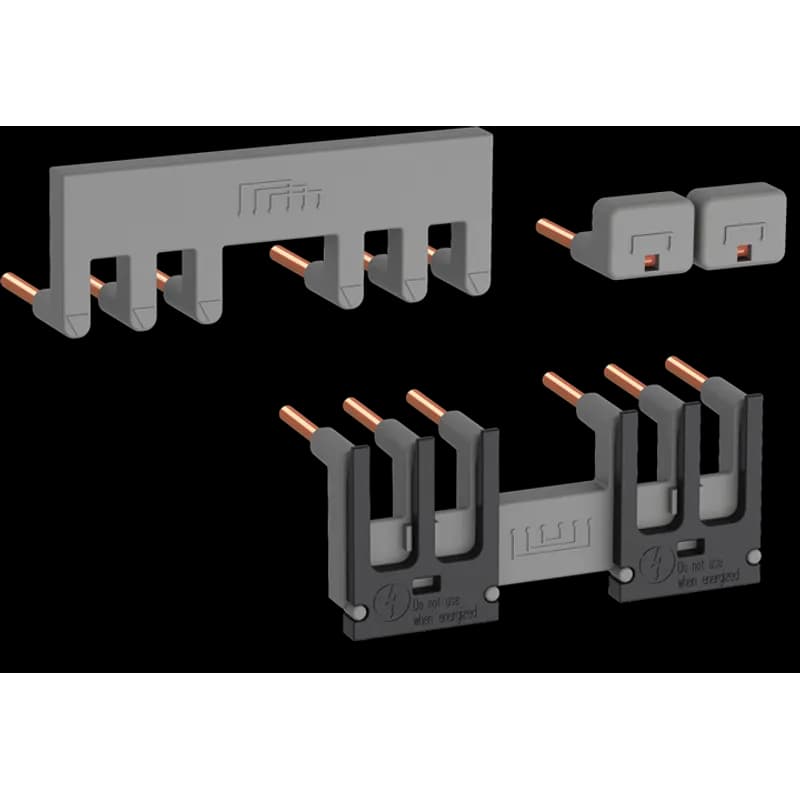
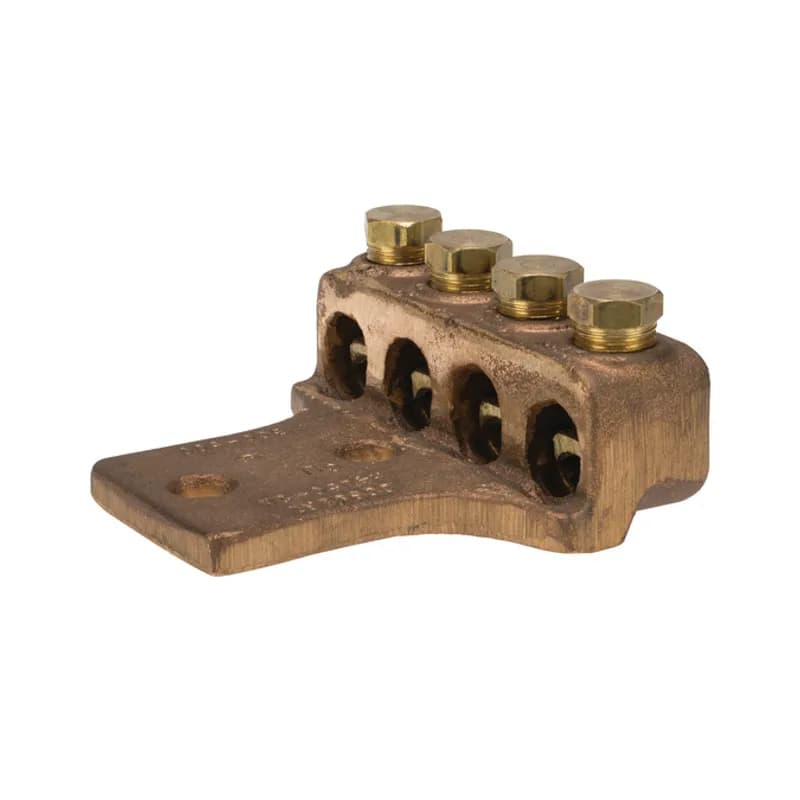
TL500-4L2
Cast Bronze Terminal Lug 500 - 300 MCM 4 Port 2 Mounting Holes Copper Terminal Lugs are made of high copper alloy. They are used for joining a wide range of cables or terminal blocks.
CB225-56-QY
One-hole, copper, single barrel, offset floating tongue lug, #2 - 4/0 AWG, 5/16 (7.9mm) stud hole.
WL2
Wide Range Insulating Sleeve for Conductors with Outer Diameter over Insulation .390 Inches -.923 Inches - for Use with 2 Bolt Connectors. Material EPDM Rubber. 600 Volts Max. Length 8-5/16 inch.UPC-SL COVER
Rubber Cover for Bus Connector Street Light Adapter Option, 2-9/32 inch x 15/16 inch Diameter.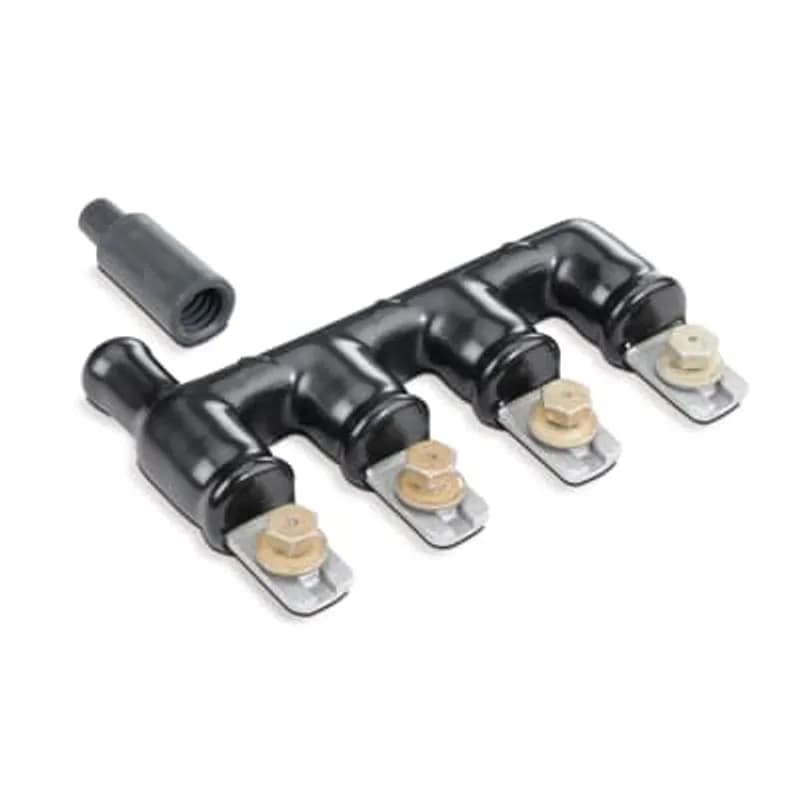
UPC44SLWL2P
Insulated Bus Connector - 5 Terminals In-Line, Number of Ports 4, 4 WL2P Sleeves Plugged for Insulation, Wire Range 12 solid - 4 stranded for Street Light Option
AT3 A 4-1000 N
Tin Plated Aluminum Mechanical Lug, 500 - 1000 kcmil for CU9AL, Bolt size 1/2 inch, Three 1-7/32 inch Diameter Barrels, Four hole pad. Includes (6) Tin Plated Aluminum Screws 1-14 1.187 inch long and Wax Dipped. Total Length 6-3/16 inch x 4-47/64 inch wide. Pad thickness 9/16 inch. Cable Attachment Area is 1-7/8 inch tall.How to Install the DYC 2/0 Street Lighting Kit
This guide provides step-by-step instructions for assembling and wiring the DYC 2/0 street lighting kit, including cable preparation, fuse holder installation, and final assembly.
Estimated time: 1h 30m
Tools needed:
Cable diameter measuring tool, Utility knife, Wire strippers, Crimping tool with appropriate dies, Wire brush (for aluminum cable)
Supplies needed:
Y-Type housing, Load side (Plug) housing, Line end insert, Fuse holder, Connecting link (DYA & DYC only) or Fuse (13/32" x 1 1/2", 600V 30A max, non-glass), Nut, Bolt, Belleville washers, Lugs (1 set), Assembly Dowel, Lubricant, HM53 inhibitor or equivalent (for aluminum cable)
- Prepare the Load Side Housing
WARNING: Disconnect power before installation to prevent risk of shock. CAUTION: This product must be installed by a qualified electrician in accordance with national and local electrical codes. Measure the load side cable diameter and refer to Table 1 in the documentation. Cut off the corresponding sections of the load side (plug) housing to match the cable's outer diameter.
- Clean and Strip the Load Side Cable
Thoroughly clean approximately 8 inches along the load side cable end. Apply lubricant and insert the cable through the small hole in the load side (plug) housing. Push the cable through a sufficient distance to allow for 3/8 inch of insulation stripping. Strip 3/8 inch of insulation from the cable end.
- Crimp the Fuse Holder
Insert the stripped load side cable into the crimp barrel of the fuse holder. Using an appropriate crimping tool and die (refer to Table 2 in the documentation for guidance), securely crimp the fuse holder to the cable. CAUTION: Do not over strip the cable insulation.
- Install Fuse Holder into Load Side Housing
Lightly apply lubricant to the outside of the fuse holder. Place the provided wood dowel into the fuse holder's socket and position the free end of the dowel against a firm surface. Push the load side (plug) housing forward until the fuse holder snaps securely into position. Wipe off any excess lubricant.
- Insert Fuse or Connecting Link
Insert a 13/32 inch by 1 1/2 inch fuse (600 Volt, 30 Amp maximum) or the connecting link into the load side (plug) housing. WARNING: DO NOT use a glass body fuse.
- Prepare Y-Type Housing and Run Cable for Connection
For a run connection, select and cut the correct cut-off ring on the Y-Type housing for the cable being used. Cut and bevel the cable insulation. Apply lubricant to the end of the cable and the cut opening of the housing. Slide the cable through until it extends 2 to 3 inches beyond the housing. Strip the cable insulation to fit the compression lugs.
- Crimp Lugs to Run Cable
Crimp the lugs to the run cable using a proper crimping tool, ensuring the pad portions of the lugs are back to back. If using aluminum cable, wire brush the pads of the lugs, apply HM53 inhibitor or equivalent, and then wipe off any excess inhibitor.
- Assemble and Tighten the Line End Insert
Assemble the line end insert components, including the nut, bolt, Belleville washers, and lugs, as shown in the illustration. Securely tighten the bolted assembly.
- Install Line End Insert into Y-Type Housing
Apply lubricant to the mating surfaces. Slide the Y-Type housing up to the bottom of the line end insert. Push the line end insert into the opening of the Y-Type housing. While pulling on the cables and holding the Y-Type housing, slide the housing toward the line end insert. Push the line end insert until it is fully seated in the housing.
- Connect Load Side Housing to Line End Insert
Lubricate the male and female components of the connection. Insert the load side (plug) housing, with the installed link or fuse clip, into the line end insert until it is fully engaged.
Frequently Asked Questions about ABB - Installation Products
How are Thomas and Betts products typically installed?
Thomas and Betts products are installed using a variety of methods tailored to specific applications, including the use of flexible cords and cable fittings, non-metallic cable glands, and armored cable fittings. Proper selection of fittings is crucial to match the cable type and installation environment, ensuring durability and preventing physical damage. Tools such as the Blackburn® Comfort Crimp® and HEX-FLEX® systems enhance installation efficiency and reliability, reducing labor time and ensuring secure connections.
What accessories are available for Thomas and Betts products?
Thomas and Betts offers a comprehensive range of accessories for their products, including various cord and cable fittings, non-metallic cable glands, service entrance cable fittings, and armored cable fittings. Their accessories are designed to enhance installation efficiency and ensure compatibility with different cable types and environmental conditions, providing reliable connections for a wide array of applications.
What environmental ratings do Thomas and Betts products have?
Thomas and Betts products feature robust environmental ratings, including NEMA Type 1, 2, 3, 4, 4X, 12, and 13 certifications, as well as IEC 60529 IP66 protection. These ratings ensure that their products are designed to withstand harsh industrial environments, with capabilities to resist dust, water, and corrosion, and operate effectively in a wide temperature range.
What communication protocols do Thomas and Betts products support?
Thomas and Betts products support a wide range of industrial communication protocols, including Ethernet, DeviceNet, PROFIBUS, Modbus, CANopen, and others. This extensive compatibility ensures seamless integration and reliable communication across various industrial automation systems, catering to diverse application needs.
What are the key features of Thomas and Betts products?
Thomas and Betts products are known for their innovative designs, high performance, and compliance with industry standards such as the National Electrical Code and Underwriters' Laboratories. They offer a comprehensive range of rugged and reliable electrical fittings, including liquidtight and dust-tight connections, which enhance installation efficiency and reduce overall project costs. Their products are engineered for durability in harsh environments, ensuring long-term reliability and lower installed costs.
What are the main product lines offered by Thomas and Betts?
Thomas and Betts offers a comprehensive range of product lines including electrical connectors, cable management systems, grounding and bonding solutions, and industrial automation components. Their products are designed for durability and reliability in demanding industrial environments, ensuring optimal performance and safety across various applications.
What technical support does Thomas and Betts offer?
Thomas and Betts offers comprehensive technical support, including access to field application engineers for onsite training and installation assistance. Their technical support staff is available to address inquiries related to product specifications and installation practices, ensuring optimal performance and safety of electrical systems. Additionally, they provide a variety of training programs to enhance the knowledge and skills of users in the field.
What industries and applications are Thomas and Betts products used for?
Thomas and Betts products are utilized across various industries including electrical construction, industrial automation, telecommunications, and utilities. Their extensive range of cord and cable fittings, electrical boxes, and metal framing systems are designed for applications that require durability and reliability in harsh environments, ensuring optimal performance in both permanent and temporary installations.
What certifications and standards do Thomas and Betts products comply with?
Thomas and Betts products comply with critical international certifications including UL (Underwriters Laboratories), CSA (Canadian Standards Association), and CE (European Community). Our products are designed to meet rigorous industrial standards such as NEMA enclosure ratings and IEC 60529 IP ratings, ensuring safety and reliability across various industrial applications.
What are the main product lines offered by Ocal?
Ocal offers a comprehensive range of corrosion-resistant conduit systems, including PVC-coated conduit and fittings, conduit bodies, hazardous location fittings, and strut accessories. Their products are designed to provide superior corrosion protection, featuring a hot-dipped galvanizing process and UL listed Type 4X PVC-coated conduit bodies, ensuring durability in the most demanding environments.