Selecting the Right Relay for PLC Control Applications
2026-03-10
· Gross Automation
· 6 min read
Selecting the Right Relay for PLC Control Applications
When you're designing an industrial control panel, one of the most fundamental decisions you'll make is choosing the right relay to interface between your PLC outputs and the loads you need to control. Get this wrong, and you're looking at premature failures, nuisance downtime, and costly panel redesigns. Get it right, and you have a reliable, cost-effective control architecture that runs for years without issues.
The challenge is that relay selection isn't one-size-fits-all. A relay that works perfectly for switching LED lighting won't necessarily handle a motor load safely. And the cheapest option upfront might cost you far more in maintenance and replacement cycles. This guide walks you through the decision-making process so you can specify relays with confidence.
Understanding Your Starting Point: PLC Output Voltage
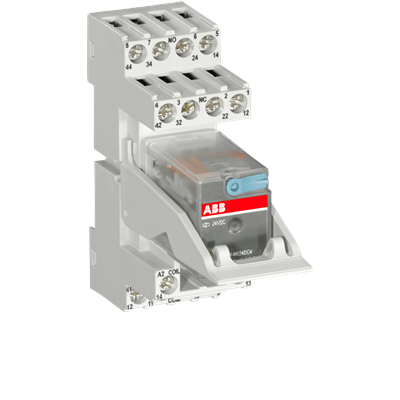
Most modern PLCs output 24VDC control signals—this is your baseline. Your relay must be rated to accept this control voltage reliably. When you're evaluating relays from manufacturers like exm, ABB - Electrification, and LS Electric, you'll see control coil ratings clearly specified. A 24VDC coil means the relay energizes when your PLC output supplies 24 volts to the coil terminals.
This is straightforward, but here's where many engineers stumble: not all 24VDC relays are created equal. Some are designed for industrial environments with voltage fluctuations, while others assume clean, stable power. In real-world control panels, your 24VDC supply might sag under load or experience transient spikes. Relays with wider voltage tolerance ranges (typically 20-28VDC) are more forgiving and reduce the risk of chatter or failure to energize.
Matching Relay Specifications to Your Load Type
The load you're switching—whether it's lighting, heating, or motors—determines the relay's contact rating requirements. This is where relay selection becomes application-specific.
Resistive Loads (Heaters and Heating Elements)
Resistive loads like electric heaters are relatively straightforward to switch. They draw steady current with no inrush spike. When selecting a relay for resistive loads, focus on the continuous current rating. If your heater draws 10 amps at 230VAC, you need a relay rated for at least 10 amps continuous at that voltage.
Look for relays with AC contact ratings clearly marked—for example, a relay rated "10A @ 230VAC" means it can safely handle 10 amps on AC circuits at that voltage. The LS Electric NS40ES-26 and NS53ES-26 are solid choices for this application class, offering reliable switching of moderate heating loads in industrial environments.
Inductive Loads (Motors and Solenoids)
Motors and solenoids present a different challenge. When you de-energize an inductive load, the collapsing magnetic field creates a voltage spike that can damage relay contacts. This is why inductive loads require relays with higher contact ratings than their steady-state current would suggest.
A motor drawing 5 amps continuously might require a relay rated for 10 amps or more, depending on the inrush current and the relay's inductive load rating. Manufacturers typically specify separate AC ratings for resistive versus inductive loads. Always use the inductive rating when switching motors or solenoids.
The ABB - Electrification 1SVR405622R1100 is designed with industrial motor control in mind, offering robust contact materials that withstand the electrical stress of inductive switching.
Lighting Loads (LED and Fluorescent)
Modern LED lighting loads are deceptively tricky. While LEDs draw less current than incandescent bulbs, they can create harmonic distortion and switching transients that stress relay contacts. Fluorescent ballasts present similar challenges with their reactive characteristics.
For lighting applications, don't just calculate the steady-state current and select a relay at that rating. Account for the reactive nature of the load by choosing a relay with a safety margin. If your LED circuit draws 3 amps, consider a relay rated for 5-7 amps to ensure longevity.
Evaluating Relay Technologies for PLC Integration
Not all relays are equal in terms of reliability and lifespan. Understanding the technology differences helps you make cost-effective decisions.
Electromechanical relays are the traditional choice. They're simple, cost-effective, and proven in industrial environments. The exm 01001.0-00 represents this category—straightforward switching with mechanical contacts. These relays have predictable failure modes and are easy to diagnose when problems occur.
Solid-state relays (SSRs) use semiconductor switching instead of mechanical contacts. They offer advantages like faster switching, longer electrical life, and immunity to vibration. However, they generate more heat and may require heatsinking in high-current applications. For PLC applications where switching speed matters and you're controlling resistive loads, SSRs can be cost-effective over their lifetime.
The choice between electromechanical and solid-state often comes down to your specific application. Electromechanical relays excel at motor control and handle inductive loads naturally. Solid-state relays shine in high-cycle applications like LED dimming or frequent on-off switching.
Practical Selection Workflow
Here's a step-by-step approach to relay selection:
- Identify your load type — resistive, inductive, or lighting
- Determine the load voltage and current — measure or calculate both steady-state and inrush current
- Select the control voltage — confirm your PLC outputs 24VDC
- Choose the appropriate contact rating — use inductive ratings for motors, resistive ratings for heaters
- Add a safety margin — select a relay rated 25-50% above your calculated requirements
- Verify environmental compatibility — ensure the relay's temperature and humidity ratings match your panel environment
- Consider cycle life — if you're switching frequently, account for contact wear
Cost-Benefit Considerations
The cheapest relay isn't always the best investment. A $15 relay that fails after 50,000 cycles costs far more than a $40 relay rated for 1 million cycles when you factor in downtime and labor.
Calculate the total cost of ownership: purchase price plus expected maintenance and replacement costs over the system's lifetime. For critical applications, investing in higher-rated relays with longer contact life pays dividends.
Getting the Right Relay for Your Application
Relay selection requires balancing technical specifications with practical constraints and budget realities. By understanding your load characteristics, matching relay ratings appropriately, and accounting for real-world operating conditions, you'll design control panels that are reliable and cost-effective.
Gross Automation stocks a comprehensive range of relays from trusted manufacturers including WEG, ABB - Electrification, and LS Electric. Whether you need 24VDC control relays for PLC switching or 230VAC output relays for your loads, our technical team can help you specify the right component for your application. Contact us today to discuss your control panel requirements and find the relay solution that works for your budget and performance needs.
Quick Answers from Products
What is the input voltage for the ABB OBOA2000-24VDC relay?
The ABB OBOA2000-24VDC relay operates with an input voltage of 24V DC.
From: 1SNA645029R0600 by ABB - ElectrificationWhat is the coil voltage for the ABB CR-U024DC3L relay?
The ABB CR-U024DC3L relay operates with a 24VDC coil voltage.
From: 1SVR405622R1100 by ABB - ElectrificationWhat is the contact current rating of this ABB relay?
The CR-U024DC3L relay has a contact current rating of 3A.
From: 1SVR405622R1100 by ABB - ElectrificationRelated Articles
When Does It Make Sense for SMBs to Automate? Evaluating ROI from PLCs to Full DCS and SCADA Systems
10 min readNavigating Obsolescence: Upgrading Legacy GE Surge Protective Devices Before 2026
6 min readMitigating Electrical Arcing and Damage in PCB Inverters: Best Practices and Solutions
6 min readNavigating Industrial Automation Market Trends Amid Rising Chinese Competition
6 min read