Contact for Pricing
Overview
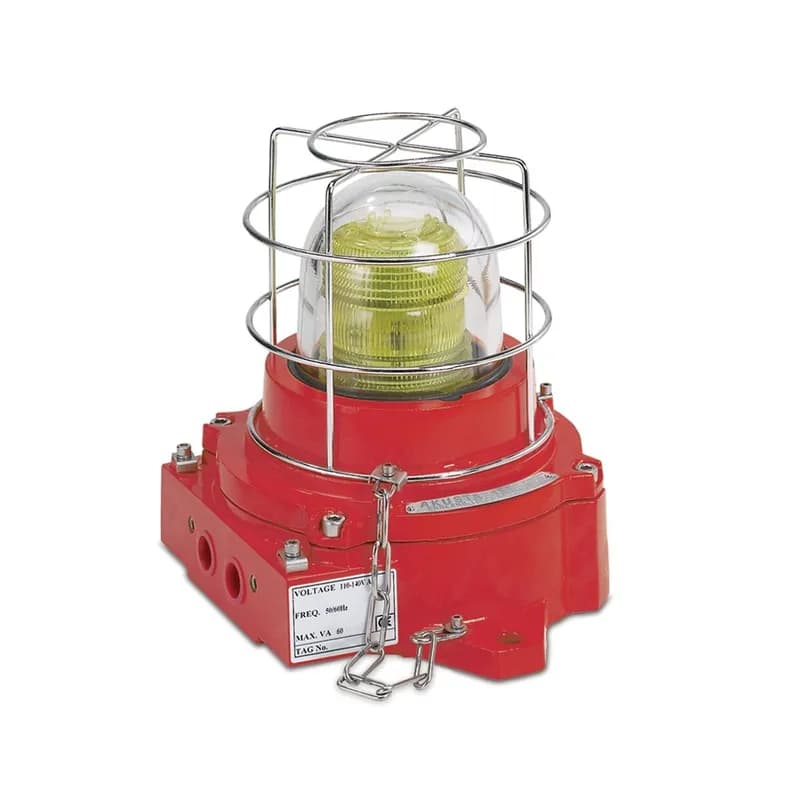
- Certified to IECEx and ATEX standards for Zone 1 (ExdeIIBT4) hazardous areas
- 240VAC operation for industrial power compatibility
- High-intensity strobe for emergency and warning signals in low-visibility conditions
- Lens sold separately for customization (clear, amber, or red options)
- Rugged construction withstands corrosive chemicals, extreme temperatures, and mechanical stress
Specifications
-40 to 158 | DEG F |
0.38 | A |
240 | VAC |
240VAC | V |
5,000 | HR |
80 | FLPM |
9.84 H x 10.04 W x 8.23 D | IN |
Amperage | 0.38 A |
Amperage Rating | 0.38 AMP |
Application | Indoor/Outdoor |
Average Life | 5,000 HR |
Brand Name | Federal Signal |
Color | Red |
Color | Colored Lens Sold Separately |
Environmental Conditions | -40 to 158 DEG F |
Flashes Per Minute | 80 FLPM |
Light Source | Xenon Tube |
Material | Cast Aluminum Housing/Stainless Steel External Hardware |
Model | XEN1 |
Mounting | Surface |
NEMA Rating | IP66 Enclosure |
Operating Temperature | -40D to +158DF (-40D to +70DC) |
Shape | Cylindrical |
Size | 9.84 H x 10.04 W x 8.23 D IN |
Special Features | For use In Hazardous Locations Requiring ATEX Approval |
Standard | ATEX Certified/IECEx Certified/CE Certified |
Standard | ATEX,CE,IECEx |
Style | Strobe |
Type | Flameproof Strobe Light |
Voltage Rating | 240 VAC |
Package Dimensions (L x W x H) | 11.19 IN x 13.56 IN x 12.13 IN |
Package Dimensions (L x W x H) | 28.4226 cm x 34.4424 cm x 30.8102 cm |
Package Weight (Imperial) | 16.500 L |
Package Weight (Metric) | 7.484 kg |

Frequently Asked Questions
What are the main types of 2000 Series beacons?
The 2000 Series includes Model XEN1, a single xenon strobe, and Model XEN4, a four-strobe version simulating a rotating beacon.
What environments are these beacons approved for?
These beacons are approved for use in Zone 1, 2, 21, and 22 atmospheres, and are ATEX, IECEx, and CE Certified.
What is the ingress protection rating of the beacon?
The 2000 Series beacon has an IP66 enclosure, meaning it is sealed from dust and water by a nitrile rubber o-ring seal.
What are the available power options for XEN1 and XEN4?
Both XEN1 and XEN4 models can be powered by 24VDC, 48VDC, 110VDC, 110VAC, or 240VAC sources.
What is the operating temperature range for the beacons?
The operating temperature range for both Ex d and Ex de versions is -40°C to 70°C (-40°F to 158°F).
What is the expected lamp life for the strobe light?
The lamp life for the strobe light source is 5,000 hours.
What type of cable entries do the beacons have?
The beacons feature four metric cable entries, M20 x 1.5, with other configurations available upon request.
How are the 2000 Series beacons mounted?
The beacons are mounted via fixed cast lugs at two mounting points.
What materials are used for the beacon's exterior?
The body is marine grade alloy painted Regal Red, with a toughened glass exterior dome and a 316 stainless steel guard.
Are colored lenses included with the beacon?
No, colored xenon lenses are sold separately. Available colors include Amber, Blue, Clear, Green, Red, and Yellow.
Frequently Asked Questions about Federal Signal
What certifications and standards do Federal Signal products comply with?
Federal Signal products are certified across multiple international standards, including UL (Underwriters Laboratories) in the USA, CSA (Canadian Standards Association), CE (European Community), UKCA (United Kingdom), EAC (Russia), and C-Tick (Australia and New Zealand). Their products meet rigorous safety and performance standards for industrial environments, with specific compliance in electrical equipment enclosures, functional safety, and environmental protection ratings.
What is Federal Signal's warranty policy?
Federal Signal offers a comprehensive limited warranty covering most products for 1-5 years from the date of delivery, with specific terms varying by product category. Mechanical sirens, beacons, speakers, and sounders typically receive 5-year parts and labor coverage, while electronic sirens and controllers generally have 2-year warranties. All warranties require return to the factory for service, and on-site services are not included. Certain components like domes, lenses, lamps, and batteries are specifically excluded from warranty coverage.
What industries and applications are Federal Signal products used for?
Federal Signal products are used across multiple critical industrial and municipal sectors for notification, communication, and safety systems. Their product lines cover essential applications including fire alarm systems, public address and telephony, outdoor warning systems, visual and audible signals, and emergency communication networks. Key industries served include manufacturing, municipal emergency services, industrial facilities, and infrastructure environments where clear, reliable communication and safety signaling are paramount.
What technical support does Federal Signal offer?
Federal Signal offers comprehensive technical support through their dedicated [email protected] email and direct phone line at +1 708.534.4756. Their support covers a wide range of notification and communication solutions, including technical assistance for products in public address, telephony, fire alarm, visual and audible signals, outdoor warning systems, and intercoms.
What are the main product lines offered by Federal Signal?
Federal Signal offers comprehensive notification and communication solutions across multiple product lines, including Visual Signals, Audible Signals, Telephony, Intercoms, Fire Alarm, Outdoor Warning Systems, Public Address, and Initiating Systems. Their product range is designed to provide clear communications and critical process notifications that enhance safety and compliance in industrial and public environments.
What are the key features of Federal Signal products?
Federal Signal products are comprehensive notification solutions designed to enhance safety and communication across industrial environments. Their key features include visual and audible signals, fire alarm systems, outdoor warning systems, public address capabilities, telephony, and intercoms. These products provide critical process notifications, ensure safety compliance, and offer advanced technologies like secure encrypted communication, cloud-based control systems, and customizable emergency response interfaces.
What environmental ratings do Federal Signal products have?
Federal Signal products offer robust environmental ratings across multiple standards, including UL 508A, CSA, NEMA, and IEC 60529. Their enclosures are rated for Type 1, 2, 3, 4, 4X, 12, and 13 environments, with IP66 protection, and can operate in temperatures ranging from -40°F to 266°F. These ratings ensure superior protection against dust, water, corrosion, and extreme conditions for indoor and outdoor industrial applications.
What accessories are available for Federal Signal products?
Federal Signal offers multiple accessories for their signaling products, including coupling kits, cable entry adapters, indicator rings, legend plates, and mounting brackets. Key accessories include E-Box endcap kits with M20 and M25 openings, U-Brackets for dual configurations, and color-coded indicator rings in black, blue, green, magenta, red, and yellow. Additional options like adapters for NPT connections and specialized mounting hardware are also available for their Global Series signaling platforms.
What communication protocols do Federal Signal products support?
Federal Signal supports multiple industrial communication protocols including PROFIBUS DP, PROFINET, EtherNet/IP, CANopen, and Modbus RTU. These protocols enable flexible network integration across various industrial automation environments, supporting both traditional fieldbuses and modern Ethernet-based communication standards.
How are Federal Signal products typically installed?
Federal Signal products are typically installed using professional mounting configurations that include wall brackets, base stations, and specialized mounting hardware. Depending on the specific product line—such as outdoor warning systems, visual signals, or audible signals—installation involves precise mounting options like wall-mount antenna brackets, base station radio packages, and modular component assemblies. Each product configuration includes specific mounting accessories like endcaps, adapters, and terminal blocks to ensure secure and compliant installation in industrial and safety-critical environments.