
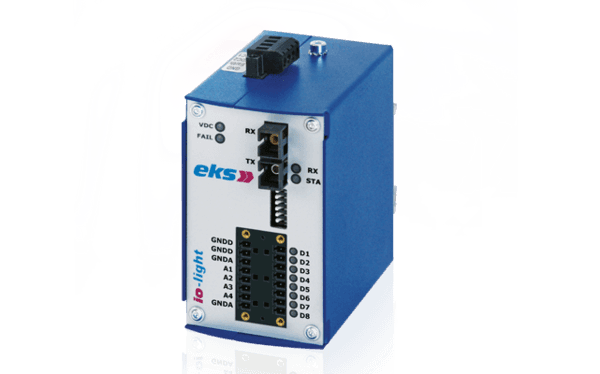
EKS Engel 010007421-FV-V2 DL-CAN-FV-V2/1x13-MM-ST CAN/MM/point to point / Fiber View
Alternate Item Number: 10007664
Documents & Media
Contact for Pricing
Call +1 (262) 252-1600 (toll-free 877-268-3700) or email [email protected] for pricing and availability.
Overview
- CAN/MM interface for point-to-point fiber optic connections
- MM-ST connector type for multimode fiber (short to medium distance)
- FiberView technology for real-time monitoring and diagnostics
- Galvanic isolation and EMI immunity for industrial environments
- Compact design for seamless integration into existing CAN networks
Specifications
CAN Cable length | Acc. to CAN Specification |
CAN Connector | 9-pole Sub-D female and 6-pole terminal |
Data rate max. | 10, 20, 22,2, 50, 100, 125, 250, 500, 800, 1000 KBaud Switchable: none or wave impedance (Rw + Rpd + Rpu) |
Dimensions | 60 x 100 x 113 mm (60 x 120 x 113 mm incl. connector) |
EMC | EN61000-6-2/EN55022 Class B + A1 + A2 |
Fiber type | Multimode 62,5 (50)/125 μm |
FO range | 5 km (1 dB/km) |
FO-connector | ST |
Housing | Stainless steel, powder coated |
Identifier | 11 Bit, 29 Bit or both |
Manufacturer Page | https://www.eks-engel.de/en/products/industrial-network-technology/interface/the-dl-can-fv-dl-can-r/ |
Operating temperature | –40 °C – +70 °C (Multimode and Singlemode with ST or SC) / –20 °C – +55 °C (all others) |
Optical budget | 12 dB |
Potential separation | 500 VDC (24 VDC <> CAN) |
Power consumption | 5 Watts, 200 mA (24 V) |
Power supply | 12–30 VDC, other voltages on request |
Product Description | The systems DL CAN connect CAN field bus networks (e.g. CAN, CANopen, DeviceNet) via fiber optics. With the help of this innovative system, optical bus, star, tree and mixed structures are possible. |
Series | DL CAN-FV / DL CAN-R |
Status-LEDs | Power supply (green) / Failure (red) / Data receive (green) / Status (red) / FiberView (red, yellow, green) |
Terminating resistor | Switchable: none or wave impedance (Rw + Rpd + Rpu) |
Transmission type | Half duplex |
Wavelength | 1310 nm |
Weight | 570 g |


Frequently Asked Questions
What is the operating voltage for the DL-CAN-FV devices?
The devices operate on 12-30 VDC. Other voltages are available upon request.
What is the maximum operating temperature for this device?
The operating temperature is -40°C to +70°C for Multimode and Singlemode with ST or SC connectors, and -20°C to +55°C for all others.
What is the maximum operating distance for the fiber optic connection?
The operating distance varies by fiber type: 50 m for POF, 5 km for Multimode, and 30 km for Single-mode.
What safety precautions should be taken with the laser components?
Do not look into the beam of the optical transceivers with optical instruments, as this can cause eye damage.
How is the device installed on a DIN rail?
Snap the system onto the DIN EN rail and check that it is securely fastened.
What are the dimensions of the DL-CAN-FV device?
The dimensions are 60 mm width, 120 mm height, and 110 mm depth.
Can the device be powered redundantly?
Yes, two power inputs (PWR1 and PWR2) allow for a redundant voltage supply and include reverse voltage protection.
How should the device be disposed of?
The units must not be disposed of with normal household waste but can be returned to eks Engel FOS GmbH & Co. KG for disposal.
What is the maximum current consumption of the device?
The current consumption is 150 mA at 24V or 300 mA at 12V.
What is the purpose of the FAIL LED?
The red FAIL LED indicates a collective failure signal or a faulty received optical signal.
Frequently Asked Questions about EKS Engel
What certifications and standards do EKS Engel products comply with?
EKS Engel products meet multiple international certification standards, including UL (USA/Canada), CE (European Community), UKCA (United Kingdom), EAC (Russia), and C-Tick (Australia & New Zealand). They comply with critical functional safety standards such as EN 61800-5-2, EN ISO 13849-1, EN 62061, and IEC 61508, covering electrical equipment safety, machinery control systems, and environmental protection requirements. Key mechanical and electrical standards include EN 60529 (IP protection), UL 50 (electrical enclosures), and IEC 61800-9-2 (ecodesign for power drive systems).
What industries and applications are EKS Engel products used for?
EKS Engel products are used across multiple critical industrial sectors, including Oil & Gas, Petrochemical, Power Generation, Water Treatment, Manufacturing, Crane & Hoist, HVAC, and Textile industries. Their fiber optic communication systems and electronic solutions are specifically designed for applications like pumps, compressors, conveyors, cranes, hoists, fans, mixers, and industrial machinery that require high-performance data transmission and reliable electronic systems.
What technical support does EKS Engel offer?
EKS Engel offers comprehensive technical support through their dedicated Competence Center, available Monday to Friday from 9:00-16:00 at +49 2762 9313-850. Their technical support includes individual troubleshooting, product and project consulting, on-site support, and FO basic training courses covering fiber optic technologies, network concepts, and specialized technical assistance. For after-hours support, customers can email [email protected].
What are the key features of EKS Engel products?
EKS Engel products are high-performance electronic systems specializing in industrial communication and fiber optic data transmission. Key features include modular devices with advanced technologies like Power over Ethernet (PoE), wide temperature range compatibility, and customized engineering solutions. Their products are designed for critical applications in smart city infrastructure, industrial networks, and IoT solutions, with a strong emphasis on security, reliability, and performance.
What communication protocols do EKS Engel products support?
EKS Engel communication modules support multiple industrial communication protocols, including PROFIBUS DP, PROFINET, EtherNet/IP, CANopen, Modbus RTU, Modbus TCP/IP, DeviceNet, and IEC 61850. Their flexible product range allows single and combination protocol configurations, enabling seamless integration with various industrial automation systems and PLCs.
What environmental ratings do EKS Engel products have?
EKS Engel enclosures feature robust environmental ratings, including IP66/67 protection, NEMA Type 4X certification, and UL/CSA standards for indoor and outdoor applications. Their products are designed to withstand harsh environments, offering protection against windblown dust, rain, splashing water, and external ice formation, with operating temperatures ranging from -40°C to 130°C.
What accessories are available for EKS Engel products?
EKS Engel offers an extensive range of accessories for their industrial enclosures, including mounting plates, DIN rails, depth extension frames, wall fastening lugs, hinges, and flange gaskets. Key accessories include galvanized steel mounting plates in multiple sizes, polycarbonate depth extension frames, 35mm DIN rails, wall mounting lugs, plastic hinges, and specialized gasket sets for different enclosure sizes.
What are the main product lines offered by EKS Engel?
EKS Engel offers multiple core product lines focused on industrial communication and fiber optic technologies, including: Router & Ethernet Extenders, Passive Fiber Optic Systems (FIMP series), SFP Modules, Power Supplies, and Industrial Enclosure Accessories. Their flagship product lines emphasize high-performance electronic systems for data transmission via fiber optics, with a range of modular devices designed for robust industrial environments.
How are EKS Engel products typically installed?
EKS Engel fiber optic communication products are typically installed by trained technical personnel following a comprehensive commissioning process. This involves a detailed work environment inspection, electrical installation verification, internal and external system checks, power-up and setup, and operational testing to ensure compatibility with the customer's specific industrial communication requirements. The company emphasizes precise, efficient installation that meets high-performance standards and ensures system reliability.