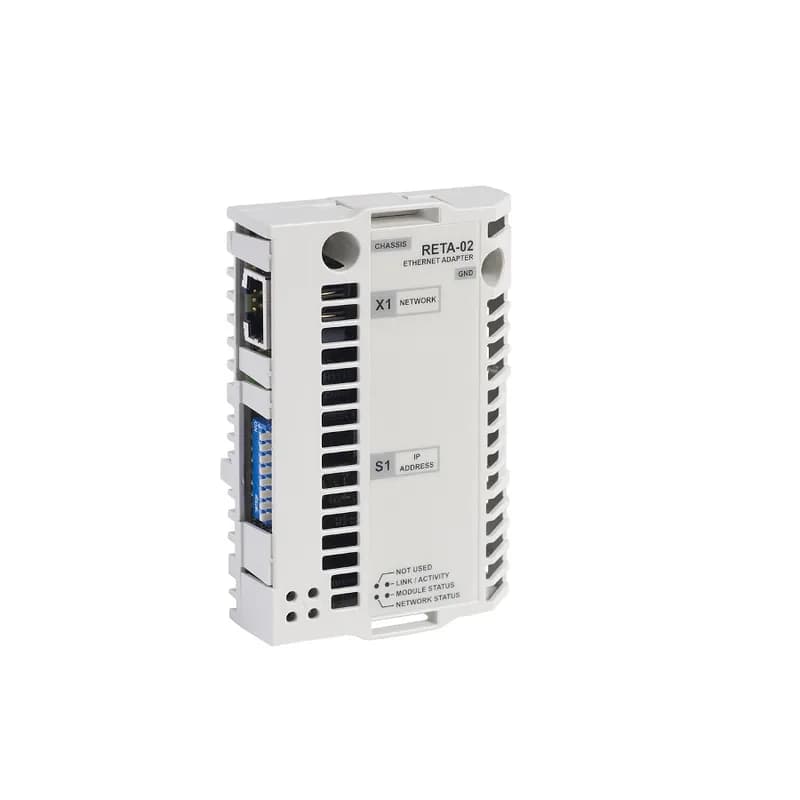
ABB Low Voltage Drives RETA-02-KIT The RETA-02 module supports both Modbus/TCP and PROFINET IO network protocols.…
Alternate Item Number: 68840830
UPC: 662348077160
Documents & Media
Contact for Pricing
Call +1 (262) 252-1600 (toll-free 877-268-3700) or email [email protected] for pricing and availability.
Overview
- Dual-protocol support: Modbus/TCP and PROFINET IO for versatile automation integration
- 10/100 Mbps transfer rate with CAT 5 cabling and RJ-45 connectors
- Supports star and bus topologies for flexible network design
- Operates in Vendor mode and PROFIdrive mode for configuration and control
- Compatible with ABB drives: ACS550, ACQ550, ACS800, ACQ800, DCS800



Frequently Asked Questions
What is the RCAN-01 adapter compatible with?
The RCAN-01 adapter is compatible with ACS550, ACQ550, ACS800, ACQ800, and DCS800 drives.
What CANopen standard does the RCAN-01 adapter fulfill?
The RCAN-01 adapter fulfills the CiA (CAN in Automation) standard DSP 402 for Device Profile Drives and Motion Control.
Which ABB drives support the RCAN-01 CANopen adapter?
The RCAN-01 adapter supports ACS550, ACQ550, ACS800, ACQ800, and DCS800 drives.
What is the baud rate range for CANopen with RCAN-01?
The baud rate for CANopen with the RCAN-01 ranges from 10 kbit/s to 1 Mbit/s.
How many devices can be connected with RCAN-01?
The RCAN-01 adapter supports a maximum of 127 devices on the network.
What is the purpose of ABB's protocol network adapters?
These adapters provide universal connectivity to all major controllers and communication networks, allowing users to choose the best network for their needs.
What are the benefits of network connectivity for ABB drives?
Network connectivity decreases installation time, reduces downtime, provides more data at lower cost, and allows for remote data access.
What does CANopen device profiles define?
CANopen device profiles define direct access to drive parameters and time-critical process data communication.
What are some end-user benefits of ABB Network Connectivity?
End-user benefits include decreased installation and start-up costs, reduced downtime, increased productivity, and lower maintenance costs.