Contact for Pricing
Overview
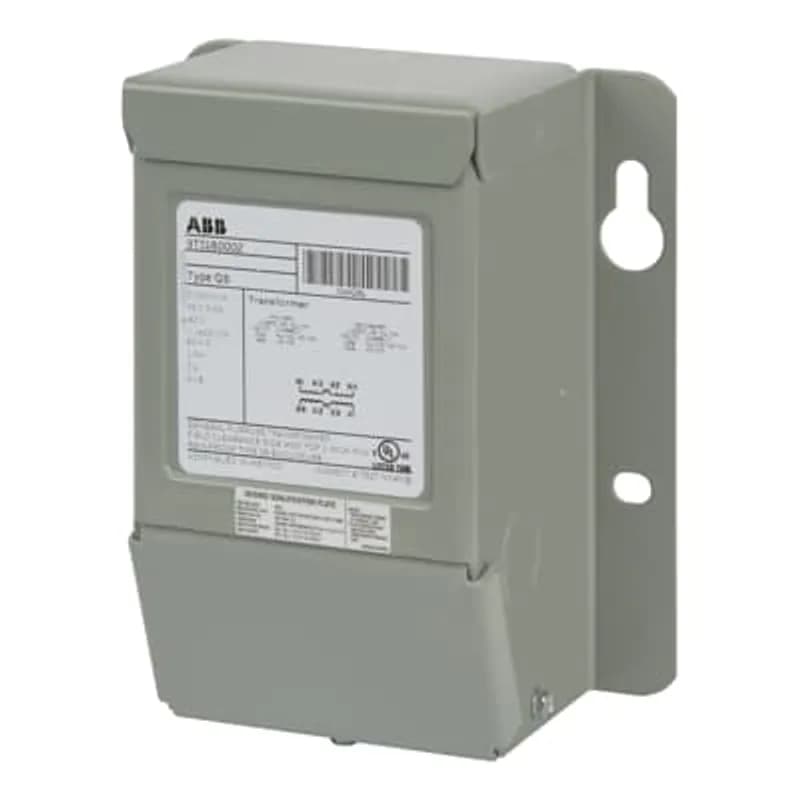
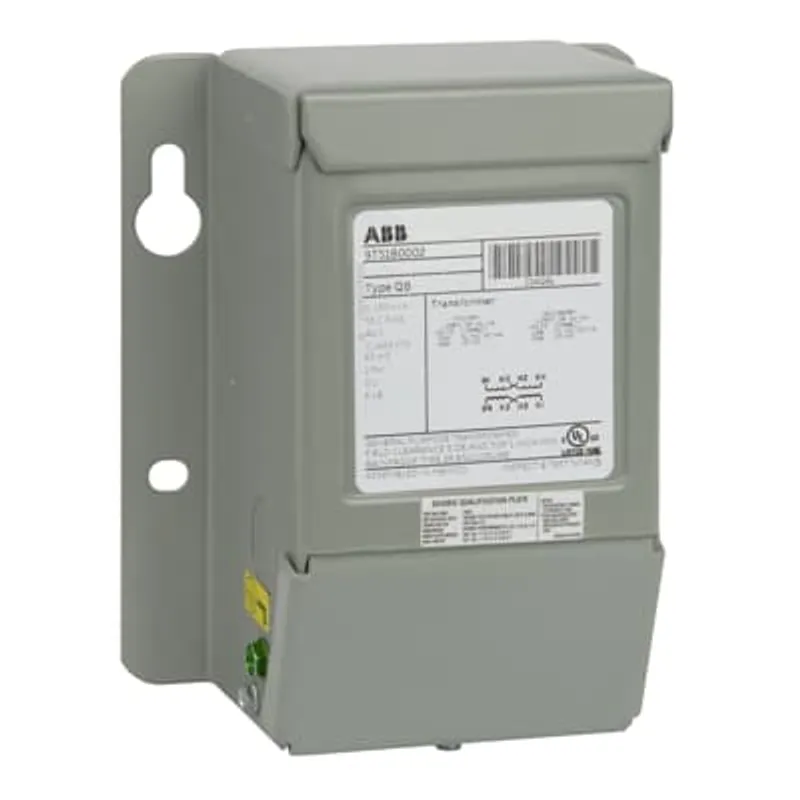
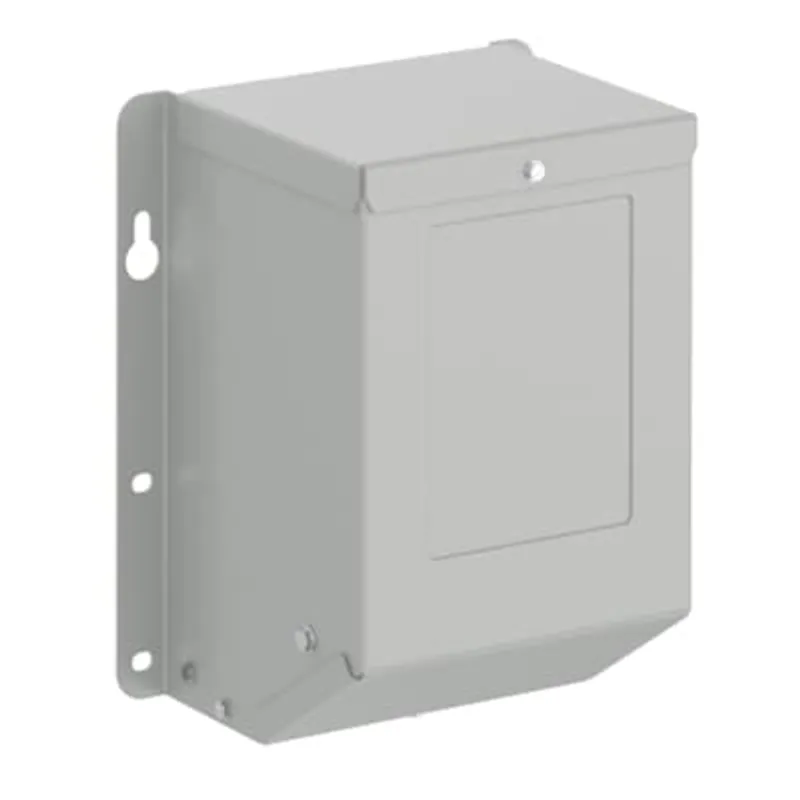
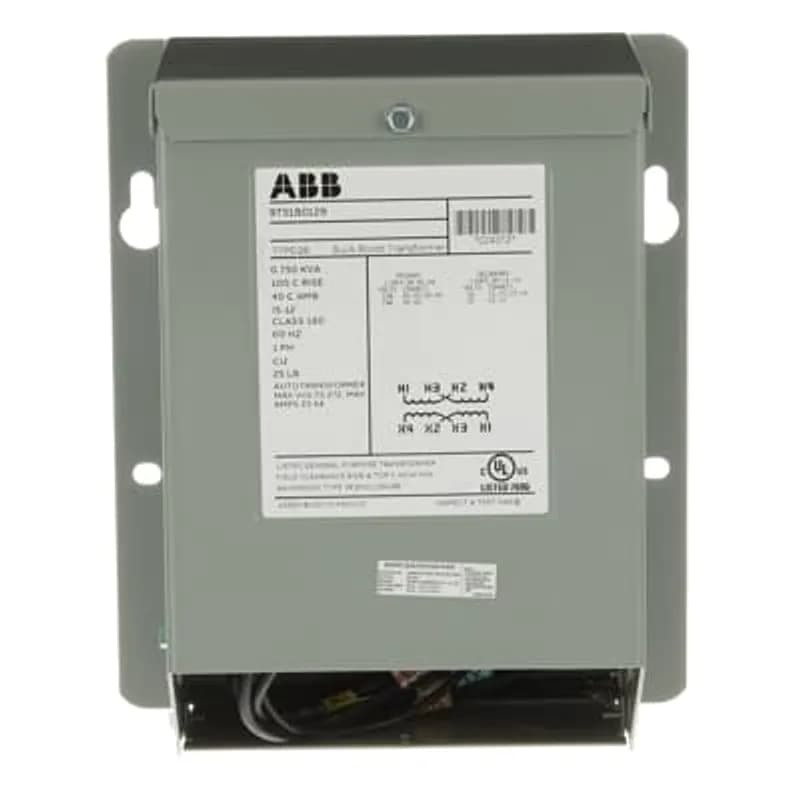
- Single-phase, dry-type distribution transformer
- Designed for bucking (lowering) or boosting (raising) voltage by 5-27%
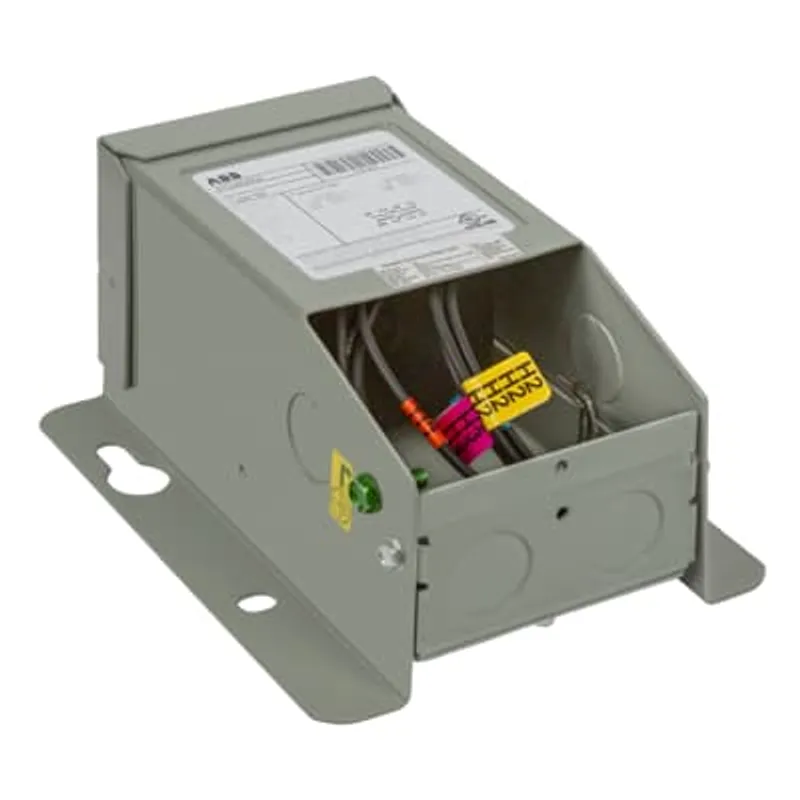
- Dual voltage primary and secondary for flexible configurations
- Complies with NEC Article 210-9, Exception 1 when field-connected as autotransformer
- Manufactured in the USA by ABB Electrification
Specifications
Connection Type | Field-configurable for autotransformer |
Connection Type | Field-connected as autotransformer |
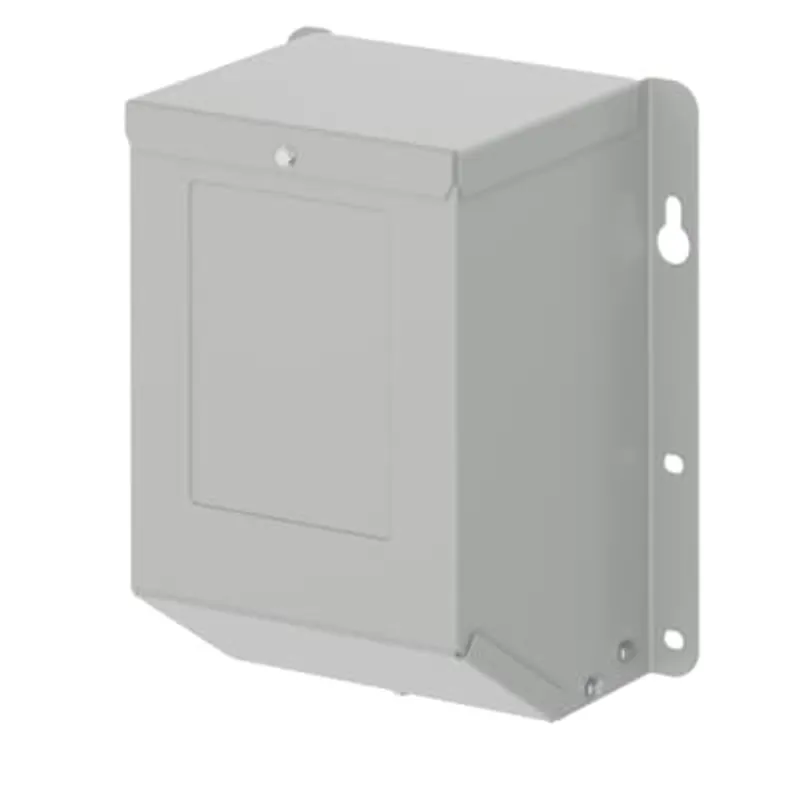
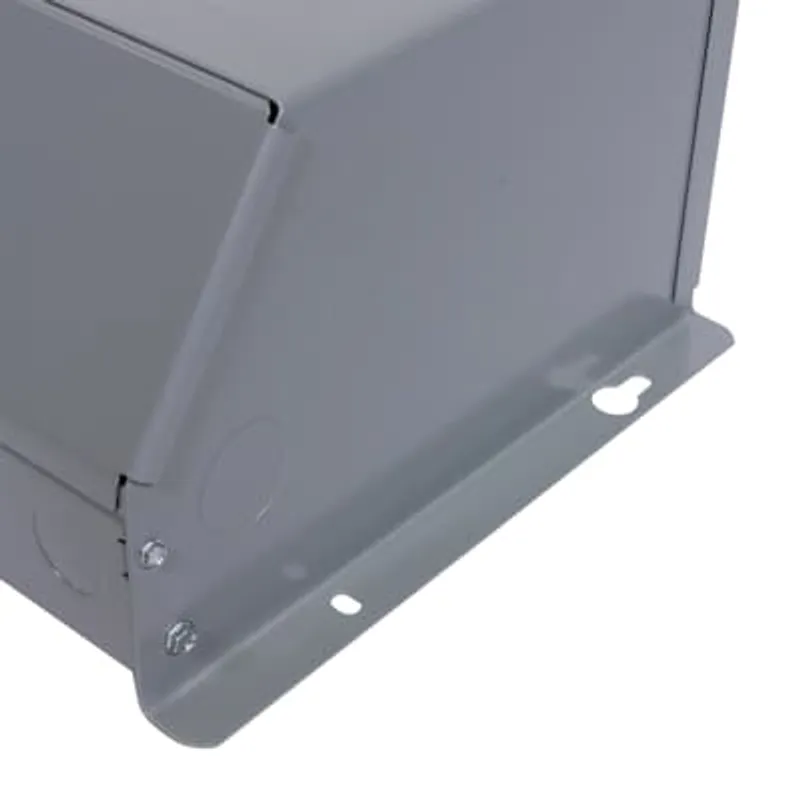
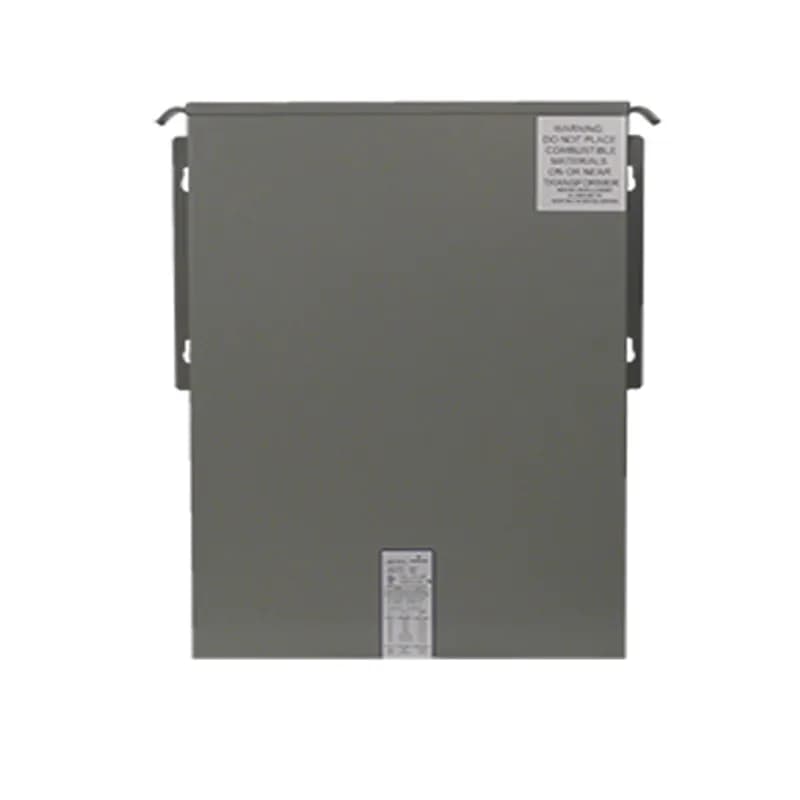
Enclosure | NEMA 3R |
Frequency | 50/60 Hz |
Frequency Rating | 60 HZ |
Height | 13.12 in |
Input Voltage | 120x240 |
Insulation | IS-12 |
Material | Dry type |
Output Voltage | 12/24 |
Phase | 1 |
Poles | Single Phase |
Poles | Single-Phase |
Series | Buck-Boost |
Special Features | ABB's Buck-boost transformers are small, single phase, dry type distribution transformers designed and shipped as insulating/isolating transformers. They have a dual voltage primary and a dual voltage secondary. These transformers can be connected for a wide range of voltage combinations. The most common use is to buck (lower) or boost (raise) the supply voltage a small amount, usually 5 to 27%. Buck boost transformers comply with NEC Article 210-9, Exception 1, when field connected as an autotransformer. |
Standard | Yes |
Temperature Rating | 40 °C |
Wattage | 3 KVA |
Width | 9.38 in |
Package Dimensions (L x W x H) | 6.72 IN x 9.38 IN x 11.12 IN |
Package Dimensions (L x W x H) | 17.0688 cm x 23.8252 cm x 28.2448 cm |
Package Weight (Imperial) | 55.000 L |
Package Weight (Metric) | 24.948 kg |

Frequently Asked Questions
What is the primary function of the ABB 9T51B0113 transformer?
The primary function is to buck (lower) or boost (raise) the supply voltage by a small amount, typically 5% to 27%.
Does this transformer comply with NEC Article 210-9?
Yes, when field-connected as an autotransformer, it complies with NEC Article 210-9, Exception 1.
What is the construction type of this ABB transformer?
This is a dry-type distribution transformer, designed for enhanced safety and reduced maintenance.
What is the typical voltage adjustment range for this buck-boost transformer?
The typical voltage adjustment range is between 5% and 27% to buck or boost the supply voltage.
Is this transformer shipped as an insulating or isolating unit?
The ABB 9T51B0113 is designed and shipped as an insulating/isolating transformer.
What is the kVA rating for the 9T51B0502 model?
The ABB 9T51B0502 model has a kVA rating of 0.05.
What are the input and output voltages for the 9T51B0007 model?
The 9T51B0007 model has an input voltage of 240 x 480 Volts or 480 Volts and an output voltage of 120/240 Volts.
Does the 9T51B0548 model have taps?
Yes, the 9T51B0548 model features taps with a setting of -2: 5.0%.
What is the weight of the 9T51B0502 transformer?
The ABB 9T51B0502 transformer weighs 6 lbs.
What types of voltage inputs and outputs are available?
The transformer features dual voltage primaries and dual voltage secondaries, allowing for a wide range of voltage combinations.
Frequently Asked Questions about ABB - Electrification
What industries and applications are Jokab Safety products used for?
Jokab Safety products are specifically designed for machine safety applications across multiple critical industrial sectors, including Food and Beverage, Packaging, and Material Handling industries. Their safety solutions cover a wide range of machine safeguarding needs, such as safety light guards, safety controllers, safety relays, safety edges, safety mats, and two-hand control devices that protect personnel and equipment in complex industrial automation environments.
What technical support does Jokab Safety offer?
Jokab Safety offers comprehensive technical support through multiple channels, including a dedicated technical support phone line at (888) 385-1221 (Option 1) and email support at [email protected]. For advanced technical assistance, customers can contact their specialized Jokab Tech Support at (519) 982-0976 or email [email protected]. Additionally, they provide product specialist support through Jeff Leslie, who can be reached at (519) 982-0976, offering in-depth application and technical guidance.
What are the main product lines offered by Jokab Safety?
Jokab Safety offers a comprehensive range of machine safety products including safety light guards (Orion), safety controllers (Pluto), safety relays (Sentry), safety edges, safety contact mats, safety locks (Gkey), and safety sensors with OSSD and DYNlink interfaces. Their product lines are specifically designed for industrial applications in food and beverage, packaging, and material handling industries, providing robust safety solutions for machine guarding and personnel protection.
What are the key features of Jokab Safety products?
Jokab Safety products offer comprehensive industrial safety solutions with key features including: highest safety certification levels (up to PL e/Cat 4), extensive fault detection, multiple safety device types (optical safety devices, pressure sensitive devices, sensors, switches, locks, emergency stops), and innovative DYNlink technology that reduces cable requirements and simplifies installation. Their products are certified, verified, and compatible with major industrial automation systems like B&R, featuring easy M12 connector connections and a wide range of adapters to streamline safety implementation.
What certifications and standards do ABB - Electrification products comply with?
ABB - Electrification products comply with a comprehensive range of international certifications and standards, including UL (United States), CSA (Canada), CE (European Community), UKCA (United Kingdom), EAC (Russia), and C-Tick (Australia & New Zealand). Our products meet critical international standards such as IEC 60947 series for low-voltage switchgear, functional safety standards EN 61800-5-2 and ISO 13849-1, and marine classification standards from Bureau Veritas, DNV, and Lloyd's Register of Shipping.
What industries and applications are ABB - Electrification products used for?
ABB - Electrification products are engineered for critical applications across multiple industries, including Energy, Oil & Gas, Manufacturing, Power Generation, HVAC, Marine, Food & Beverage, Mining, Pulp & Paper, Water Treatment, and Automotive. Their solutions cover essential electrical infrastructure needs such as switchgear, power distribution systems, circuit protection, digital control technologies, and drive systems designed for high-reliability environments with a strong focus on sustainability, efficiency, and safety.
What technical support does ABB - Electrification offer?
ABB - Electrification offers comprehensive technical support through multiple channels, including a dedicated technical support hotline at 888-385-1221 (Option 1), available 7:00 a.m. - 5:00 p.m. CST, Monday-Friday. Their support services encompass 24/7/365 emergency services, on-site support, remote monitoring and diagnostics, installation and commissioning, equipment assessments, repair coordination, and multi-vendor technical assistance. Customers can also access resources like personnel safety training, disaster recovery support, and service agreements tailored to their specific electrification needs.
What are the main product lines offered by ABB - Electrification?
ABB - Electrification offers a comprehensive range of electrical distribution and protection products, including circuit monitoring systems, panelboards, switchgear, motor control centers, circuit breakers, softstarters, and power distribution solutions. Key product lines span low and medium voltage applications across utilities, commercial, industrial, healthcare, and manufacturing sectors, with specialized offerings like the ReliaGear® panelboards, SMISSLINE TP bus systems, and Ekip UP protection and metering relays.
What are the key features of ABB - Electrification products?
ABB - Electrification products feature advanced integrated design elements that enhance industrial performance and reliability. Key features include harmonics and EMC design, integrated DC choke, removable terminals for fast installation, USB ports for troubleshooting, and integrated Safe Torque Off (STO) functionality. The products deliver superior motor control capabilities, support both induction and permanent magnet motors, and offer robust operational features like side-by-side mounting without derating and operation at temperatures up to 45°C. Additionally, ABB's Electrification solutions emphasize digital innovation, with technologies like Novolink enabling predictive maintenance, enhanced analytics, and seamless system integration.
What communication protocols do ABB - Electrification products support?
ABB - Electrification products support a comprehensive range of industrial communication protocols, including Modbus RTU, PROFIBUS DP, PROFINET, EtherNet/IP, CANopen, DeviceNet, and IEC 61850. These protocols enable flexible connectivity across multiple industrial automation platforms, with support for various network topologies and high-speed data transmission up to 100 Mbps.